Recipe · Thailand · The Salad That Needs A Mortar

Yum Talay (ยำทะเล)

Blanched prawns, squid and whatever else the sea offered, tossed in a mortar-built dressing of chilli, fish sauce, lime and sugar — sour, salty, sweet and properly hot.

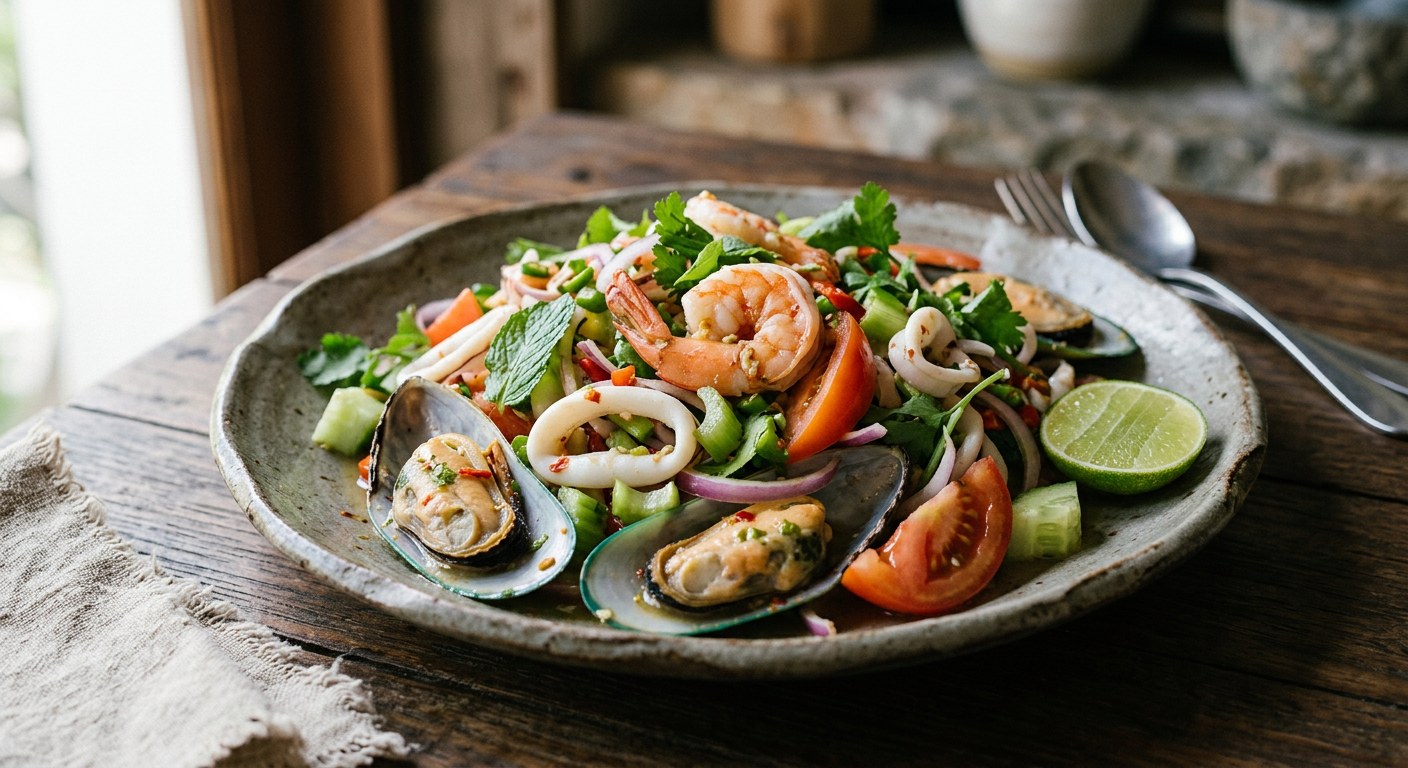
Yum Talay — Thai spicy mixed seafood salad — prawns, squid and mussels with red onion, tomato and herbs in a

The Salad That Builds Its Own Dressing

ยำทะเล is the Isaan salad logic applied to the sea: seafood blanched just long enough to cook, then tossed through a dressing pounded fresh in the mortar. ยำ (yam) is the family of Thai sour-spicy salads; ทะเล (thale) is the sea. Prawns and squid are the fixed cast; everything after that depends on the catch and the cook.

The dressing is the dish. Pa Thanawan pounds chilli and garlic first, builds fish sauce, lime and sugar into the mortar, and only then folds in the blanched prawns, squid and crab sticks. Kapook's restaurant recipe does the same, but folds in two spoons of cooked pla ra and serves it with khanom jeen and lime wedges — the vendor's version, deeper and funkier. Benenatty's family pot adds slices of moo yor and stops at a squeeze of half a lime. Longdan's recipe takes the whole thing to the noodle-salad end of the spectrum, on a bed of vermicelli with a measured three-three-three dressing.

The rules that hold across all of them: blanch the seafood once, briefly; build the dressing in the mortar; correct it by taste before the seafood goes in; fold the herbs last. Everything else is open water.

The Recipe (home version, from Wongnai / Pa Thanawan)

ThaiEnglishAmount
กุ้งPrawns200–400 g
ปลาหมึกSquid, scored and cut1 medium
หอยแมลงภู่ (ไม่บังคับ)Mussels (optional)a handful
พริกขี้หนู + กระเทียมBird's eye chillies and garlic, pounded5–8 chillies, 2 cloves
น้ำปลาFish sauce2–3 tbsp
น้ำมะนาวLime juice2–3 tbsp
น้ำตาลทรายSugar1–2 tbsp
หอมแดง / หอมใหญ่Shallots or onion, sliced2 shallots or ½ onion
มะเขือเทศ + แตงกวา + ขึ้นฉ่ายTomato, cucumber and Chinese celery1 tomato, ½ cucumber, 2–3 stalks
ผักชี + สะระแหน่Coriander and minta handful

The restaurant pot (Kapook): squid, prawns and a kilo of mussels tossed with cooked pla ra (2 tbsp), pounded jinda chillies and the dressing, served with khanom jeen and lime wedges. The family pot (Wongnai, Pa Thanawan): prawns, squid and crab sticks — dressing pounded in the mortar first, seafood blanched and folded in. The noodle salad (Longdan): vermicelli, cucumber, carrot, beansprouts and herbs with a 3:3:3 dressing of fish sauce, lime and sugar plus sesame oil, peanuts on top.

The Method

  1. The seafood. Bring a pot of water to the boil and blanch the prawns and squid just until cooked — squid goes opaque in well under a minute, and prawns pink in two. Overcooked seafood is the ruin of yum thale; every source blanches, none boils twice.
  2. The mortar. Pound the chillies and garlic until broken. Pa Thanawan pounds before anything else, because the dressing built in the mortar — chillies, fish sauce, lime, sugar — is where the dish actually happens.
  3. The balance. Stir the fish sauce, lime and sugar into the mortar and taste. The target is the same in every source: sour, salty and sweet in balance with the chilli riding on top. Adjust before the seafood goes anywhere near it.
  4. The toss. In a big bowl, toss the seafood with the shallots, tomato, cucumber and celery and pour the dressing over. Toss hard — the dressing has to reach every piece of squid.
  5. The herbs. Fold the coriander and mint through last, and serve immediately. Longdan's noodle version adds the vermicelli at the toss and peanuts at the very end.

Where Thai Sources Disagree

Noodles or not. Longdan's version is built on vermicelli; the Wongnai and Kapook pots have no noodles at all (Kapook serves khanom jeen on the side instead). A yum thale in Thailand is normally a naked salad — the noodle version is a fuller meal.

What swims in it. The core is always prawns and squid. After that it is open season: mussels by the kilo (Kapook), crab sticks (Pa Thanawan), sliced moo yor — the pink Vietnamese pork loaf — (Benenatty). Seafood availability, not doctrine, decides.

Pla ra. Kapook's restaurant recipe folds in two spoonfuls of cooked pla ra for depth; the home recipes use none. It is the difference between the vendor's version and the kitchen-table one.

The dressing ratio. Longdan is exact — three parts fish sauce, three parts lime, three parts sugar. The Wongnai home cooks season by the ladle and spoon and correct by taste. Both arrive at the same sharp-sweet-salty triangle.

How the chilli goes in. Pounded in the mortar with the garlic (Pa Thanawan, Kapook) versus sliced and tossed in whole (Longdan's salad method). Pounding carries the heat through the dressing; slicing leaves it in bursts.
How Western Versions Get It Wrong

UK Ingredient Notes

Sources

This recipe is translated from the following Thai-language sources. Where they disagree, we've said so.

1. Wongnai — "ยำทะเล" by แซ่บนัว By Pa Thanawan (the prawn, squid and crab-stick pot used here) — wongnai.com

2. Wongnai — "ยำรวมมิตรทะเล" by Benenatty (the moo-yor pot) — wongnai.com

3. Kapook Cooking — "19 เมนูร้านยำ" roundup (the restaurant-style pot with pla ra and khanom jeen) — cooking.kapook.com

4. Longdan — "วิธีทำยำรวมมิตรทะเล" (the vermicelli noodle version, adapted from BBC Food) — longdan.co.uk

Johnny Tiger
Johnny researches and translates Thai recipes from Thai-language sources — chefs, restaurants and home cooks in Thailand — and publishes them with their sources cited. No westernised shortcuts, no invented steps.