Recipe · Thailand · The Pot You Must Not Stir
Tom Yum Pla (ต้มยำปลา)
Tom yum with fish instead of prawns — herbs boiled hard, fish dropped in at a rolling boil and left alone, lime squeezed in only after the heat is off.
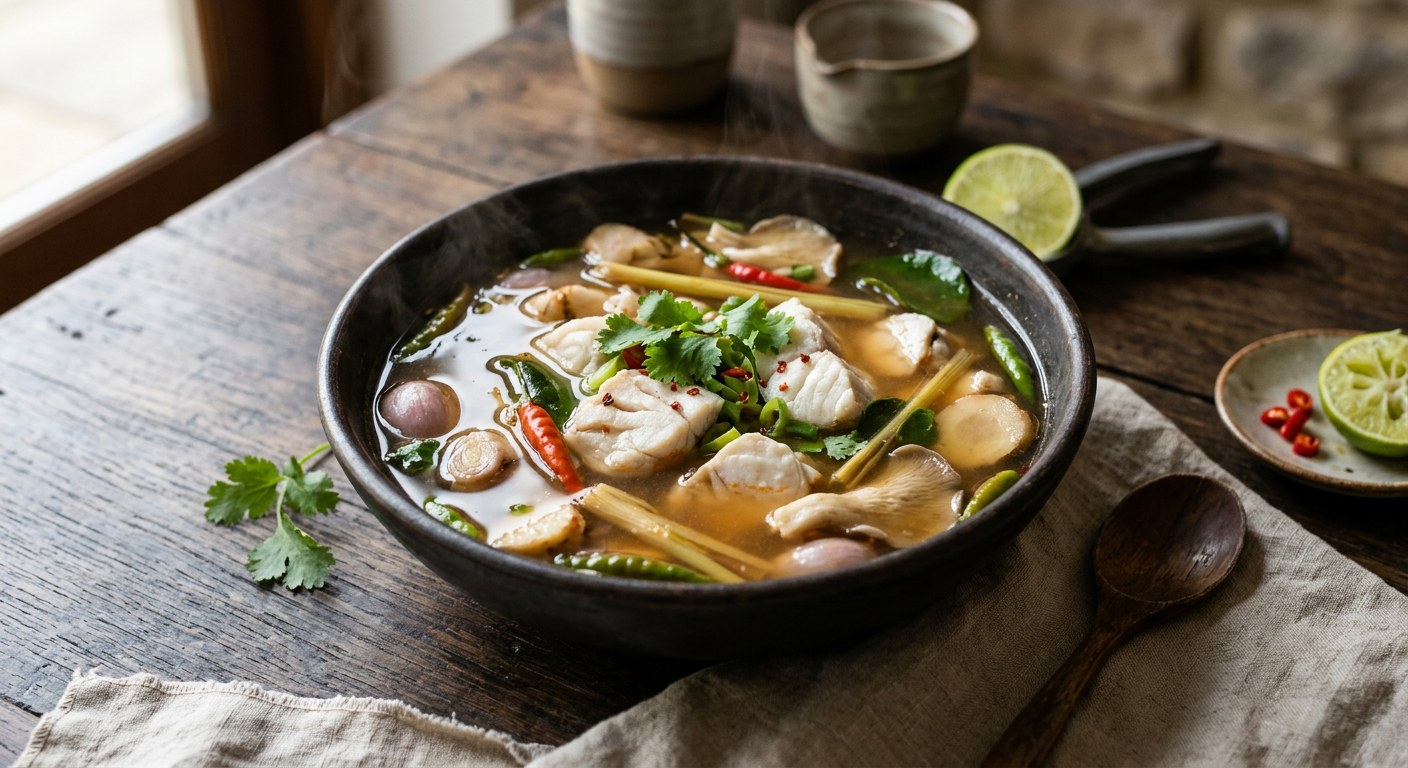
Tom yum with fish instead of prawns — herbs boiled hard, fish dropped in at a rolling boil and left alone, lime squeezed in only after the heat is off.
ต้มยำปลา is the fish version of Thailand's most famous soup, and because fish behaves differently from prawns, every Thai source leads with the same two rules. The first, from Wongnai, is absolute: ใส่แล้วห้ามคนนะคะ ไม่งั้นปลาจะคาว — once the fish goes in, do not stir, or the soup turns fishy. The second, from TrueID, is about the lime: squeezed into a boiling pot it turns bitter, so it goes in off the heat, or the soup is ladled into a bowl and seasoned there.
The anti-fishy work starts before the pot, as Kapook spells out: buy fish with clear eyes, red gills and firm scales, rub it with salt and rinse it two or three times, skim the foam as it boils — and again, do not stir until the fish is cooked. TrueID's tilapia writer adds her own count: the water must reach three boils — one for the herbs, one when the fish lands, one to finish — and the lid stays on through the whole middle stage.
Then there are the two schools. The classic is น้ำใส, the clear soup, sour from lime. The น้ำข้น (thickened) version stirs nam phrik phao — roasted chilli paste — into the broth, sometimes with a splash of milk, seasoned bowl-by-bowl at the table as Bloggang's ป้าอิ๋ว does it. A third, homier route is Wongnai's tamarind-pot: the sour comes from tamarind squeezed into the water before the fish, with lime still added at the end.
| Thai | English | Amount |
|---|---|---|
| น้ำเปล่าหรือน้ำซุป | Water or stock | 500–800 ml |
| เนื้อปลากะพงหั่นชิ้น | Seabass, cut into pieces | 400 g |
| ข่าแก่หั่นแว่น | Galangal, sliced | 1 knob |
| ตะไคร้หั่นท่อนทุบพอแตก | Lemongrass, cut and bruised | 2 stalks |
| ใบมะกรูดฉีกแกนกลางออก | Kaffir lime leaves, de-ribbed and torn | 5 leaves |
| หอมแดงบุบพอแตก | Shallots, bruised | 4 |
| เห็ดฟางหรือเห็ดออรินจิ | Straw or oyster mushrooms | 1 cup |
| พริกขี้หนูสวนบุบพอแตก | Bird's eye chillies, bruised | 10–15 |
| น้ำปลาแท้ | Fish sauce | 3 tbsp |
| น้ำมะนาวคั้นสด | Fresh lime juice | 3 tbsp |
| ผักชีฝรั่งหรือผักชีไทย | Sawtooth coriander or coriander, to garnish | a handful |
The tilapia home pot (TrueID): 1 whole tilapia (about 1 kg) cut into pieces, ½ cup lemongrass, 1 cup young red galangal, ½ cup torn kaffir leaves, one lime-sized ball of aged tamarind, 8–10 fresh red chillies pounded coarse with 4 garlic cloves, 3–4 coriander roots, 2 tsp seasoning powder, ½ tsp salt, ½ tbsp fish sauce, ½ ladle pla ra and 3½ cups of water. The creamy bowl (Bloggang): for 2 bowls — 250 g fish fillet, 10 straw mushrooms, ½ onion, a two-finger piece of galangal, 10 big kaffir leaves, 1½ tbsp nam phrik phao, ½ cup plain milk, lime, fish sauce and 15 pounded bird's eye chillies, seasoned bowl-by-bowl.
Clear or creamy. Kapook, Wongnai and TrueID all cook the clear น้ำใส version. Bloggang's ป้าอิ๋ว alone documents the น้ำข้น — nam phrik phao dissolved in the soup with plain milk poured in last, seasoned bowl-by-bowl because the lime's acid would curdle the milk in the pot. She admits she prefers the clear version at home.
The sour. Lime only, added off the heat (TrueID's seabass, Kapook). Tamarind only, going into the pot before the fish and carrying all the sour (TrueID's tilapia writer, who adds no sugar because the aged tamarind is sweet enough). Or both lime and tamarind in one pot (Wongnai's tamarind-pot recipe; a Pantip home cook who also adds MSG).
The fish. Seabass for the restaurant-style pot (TrueID), tilapia for the everyday home pot (Kapook, Wongnai, TrueID, Pantip). Tilapia is the budget staple; seabass is the upgrade — same pot, firmer fish.
Seasoning powder. TrueID's tilapia writer and the Pantip cook both use ผงปรุงรส (MSG seasoning powder); Kapook's kitchen seasons with salt, sugar, fish sauce and lime only. The Pantip thread frames it as the everyday-kitchen compromise.
The red oil. TrueID offers a nam phrik phao option: dissolve 1–2 tbsp of the paste in a bowl of the hot soup, pour it back before the fish, and add 5–6 fried dried chillies and a tomato for the classic tom yum red-oil finish. Kapook's home version skips it entirely.
This recipe is translated from the following Thai-language sources. Where they disagree, we've said so.
1. TrueID Food — "แจกสูตร วิธีทำต้มยำปลากะพงน้ำใส อร่อยแซ่บ ไม่คาว เนื้อปลาไม่เละ" (the clear-broth recipe used here) — food.trueid.net
2. Kapook — "ต้มยำปลานิล เมนูอาหารไทยรสเด็ด พร้อมเคล็ดลับการทำต้มยำปลาไม่ให้คาว" (the anti-fishy rules) — cooking.kapook.com
3. Wongnai — "วิธีทำ เมนู 'ต้มปลานิล' เมนูปลารสชาติเข้มข้น จัดจ้านถึงใจ!" (the tamarind-pot version and the no-stir rule) — wongnai.com
4. Bloggang — ป้าอิ๋ว, "ต้มยำปลาน้ำข้น — Tom Yam Pla Nam Kon" (the creamy bowl-by-bowl version) — bloggang.com
5. TrueID Food — "เมนูจากปลานิล วิธีทำต้มยำปลานิลน้ำใส ไม่คาว แซ่บๆ ง่ายๆ" (the three-boil tilapia home pot) — food.trueid.net
6. Pantip — "ขอวิธีการทำต้มยำปลานิลแบบแซ่บๆหน่อยค่ะ" (the lime-and-tamarind home compromise) — pantip.com