Recipe · Thailand · The Story Dish
Khai Look Keuy (ไข่ลูกเขย)
Boiled eggs deep-fried to a golden wrinkle, halved and drowned in sweet-sour tamarind sauce under a drift of fried shallots — the dish with the warning in its name.
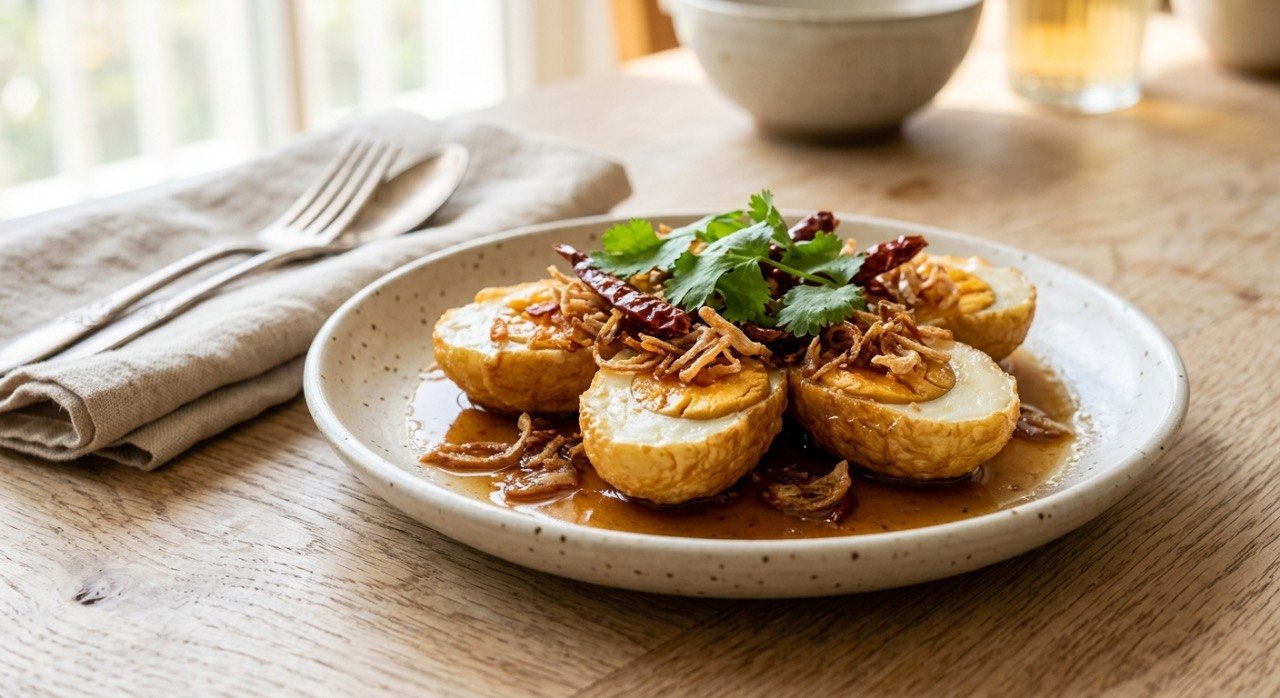
Boiled eggs deep-fried to a golden wrinkle, halved and drowned in sweet-sour tamarind sauce under a drift of fried shallots — the dish with the warning in its name.
ไข่ลูกเขย — "son-in-law eggs" — carries the old story in its name: a mother-in-law deep-fries the eggs as a warning to a son-in-law who has mistreated her daughter. Fried, not boiled — the difference is the dish. The frying turns the whites golden and wrinkled, a skin that grabs the sauce, and the deep-fried eggs become something no plain boiled egg can be.
The sauce is three ingredients, and the Wongnai recipe keeps it exactly that: tamarind water, palm sugar, fish sauce — simmered until thick. The TrueID home version takes a different road entirely, sweetening with oyster sauce, white soy and sugar instead of palm sugar and tamarind. Same name, two sauces; the tamarind one is the classic.
The finish is fried shallots — the Wongnai home recipe fries the shallots in the same oil, before the eggs, so the oil carries the onion — plus coriander and fried dried chillies. Served over or beside rice, the dish is a side that often eats like a main.
| Thai | English | Amount |
|---|---|---|
| ไข่เป็ด | Duck eggs | 8 |
| น้ำมันปาล์ม | Oil for deep frying | as needed |
| น้ำมะขามเปียก | Tamarind water | ¼ cup |
| น้ำตาลปี๊บ | Palm sugar | 3 tbsp |
| น้ำปลา | Fish sauce | 2 tbsp |
| พริกแห้งทอด | Fried dried chillies | to finish |
| หอมเจียว | Fried shallots | to finish |
| ผักชี | Coriander | to finish |
Chicken eggs work too — the TrueID source uses either, and the Wongnai home recipe boils chicken eggs for 7 minutes instead of duck eggs' 8.
The sauce. The classic is tamarind, palm sugar and fish sauce (Wongnai). TrueID's ครัวคุณพลอย version sweetens with oyster sauce, white soy and sugar — no tamarind at all. The tamarind version is the one the name belongs to.
Duck or chicken. Wongnai's recipe is duck eggs; the home recipes use chicken eggs; TrueID says either. Duck yolks are richer and the eggs fry with a deeper gold.
Boil time. Eight minutes for duck eggs, seven for chicken — the sources split by egg, not by taste.
How sour. The Wongnai home recipe runs 11 tablespoons of tamarind water to five eggs — properly sour. The classic version's quarter-cup is the balanced middle.
Shallots in the oil. The home recipe fries the shallots first and reuses the oil for the eggs; the classic version adds shallots only as a topping. The onion-scented oil is the home-kitchen refinement.
This recipe is translated from the following Thai-language sources. Where they disagree, we've said so.
1. Wongnai — "แจกสูตรฟรี ไข่ลูกเขย เมนูไข่ทำง่ายคู่บ้านคนไทย" (the recipe used here — duck eggs, three-ingredient sauce) — wongnai.com
2. Wongnai (ครัวอ๊กนี, 12.9K reads) — "ไข่ลูกเขย" (home version: shallots fried first, 11 tbsp tamarind) — wongnai.com
3. TrueID (ครัวคุณพลอย) — "ไข่ลูกเขย สูตรเด็ด อร่อยเหาะ 7 ดาว" (oyster-sauce variant, either egg) — food.trueid.net