Recipe · Thailand · The North's Herb Sausage

Sai Ua (ไส้อั่ว)

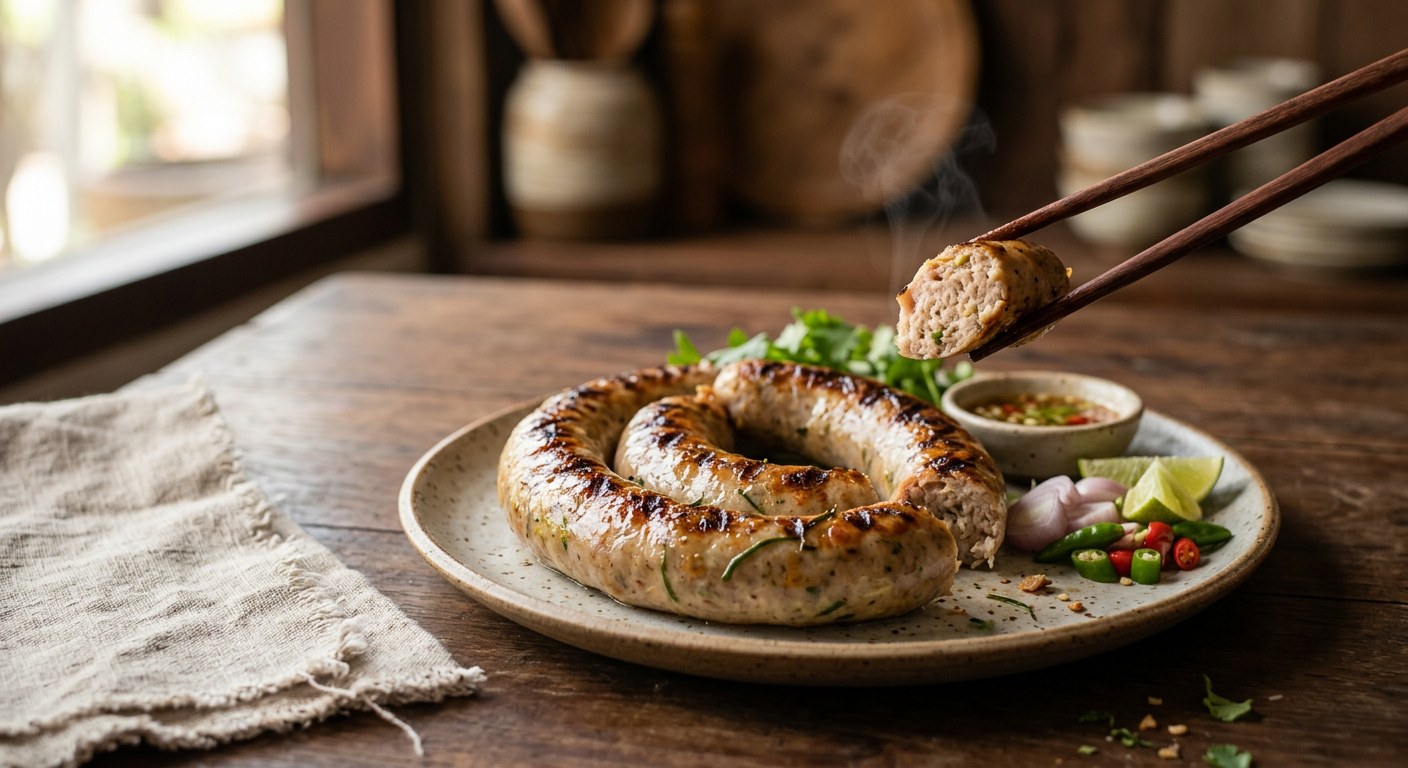
Pork kneaded with a pounded lemongrass-galangal-turmeric paste and slivered kaffir lime leaves, stuffed into casings and grilled low over charcoal — Chiang Mai's sausage, eaten with hot sticky rice.

Sai Ua — Minced pork kneaded with a pounded paste of dried chillies, lemongrass, galangal, turmeric, coriander roots and toasted

The Sausage Chiang Mai Grills

The name is a job description. Aroifin explains it: อั่ว means to stuff, to insert, to push into the middle — sai ua is literally "stuffed intestine", pork and herbs packed into a casing and grilled. Like most northern food it began as preservation: the pork, aromatics and chillies keep for a day or two, longer refrigerated or vacuum-sealed, which is exactly how the market stalls now sell it.

The build starts with a paste pounded from dried chillies, lemongrass, galangal, turmeric, coriander roots, garlic, shallots, kaffir lime zest, shrimp paste and toasted coriander seeds with cumin — the north's aromatics, the ones that announce the sausage from three stalls away. That paste is kneaded into minced pork with fish sauce, light soy and sugar, then slivered kaffir lime leaves and chopped spring onion and coriander go in. Kapook and Aroifin share the same honest step before any stuffing happens: microwave a spoonful, taste it, and fix the seasoning while you still can.

Then the fire. Kapook's home cook bakes hers at 375°F, fifteen minutes a side, and admits her husband puts it in a sandwich while she insists on ข้าวเหนียวร้อน ๆ, hot sticky rice. Wongnai's recipe steams the sausages for twenty minutes first, then grills them low over charcoal. Kapook's liver version skips the steam and grills straight over the coals — ไฟเบา ๆ, low heat, because a hot fire bursts the casing. Every source agrees on that one thing: the fire must be patient.
The Recipe (home version, from Kapook)

ThaiEnglishAmount
เนื้อหมูติดมันPork belly, minced1 kg
เครื่องแกงไส้อั่วSai ua curry paste3 tbsp
ซีอิ๊วขาวLight soy sauce1 tbsp
น้ำปลาFish sauce2 tbsp
น้ำตาลทรายSugar1 tsp
ใบมะกรูดหั่นฝอยKaffir lime leaves, slivered3 tbsp
ต้นหอม ผักชีซอยSpring onion and coriander, chopped1 cup
ไส้หมูPork casingsfor stuffing
พริกแห้งเม็ดใหญ่Dried chillies (large), soaked2
พริกขี้หนูแห้งDried bird's eye chillies, soaked15
เกลือSaltto taste
ข่าGalangal3 tbsp
ตะไคร้Lemongrass3 stalks
รากผักชีCoriander roots3 tbsp
กระเทียมGarlic1 large head
หอมแดงShallots6
ผิวมะกรูดKaffir lime zest1 tbsp
กะปิShrimp paste1 tsp
ขมิ้นTurmeric2 tbsp
ลูกผักชี ยี่หร่าคั่วตำToasted coriander seeds and cumin, pounded3 tbsp

The selling batch (Aroifin): 1.5 kg minced pork with fat, 4 tbsp red curry paste (or the pounded paste), 1 tbsp turmeric powder, 3 tbsp oyster sauce, 3 tbsp fish sauce, 2 tbsp light soy, 1 tsp brown sugar, 2 tbsp slivered kaffir leaves, 1 cup spring onion and coriander — about 15 servings, vacuum-sealed for sale. The liver build (Kapook, ไส้อั่วตับ): 1 kg lean and 2 kg fatty mince with 2 kg chopped pork liver (1 kg liver per 1.5 kg pork), market-bought น้ำพริกแกงเมือง, MSG, and low charcoal only — no steaming. The steam-then-grill batch (Wongnai): 100 g shrimp paste and 200 g coriander per 1 kg pork, steamed 20 minutes, then low charcoal.

The Method

  1. The paste. Pound the dried chillies with the salt first — Kapook and Aroifin agree on the order — then the hard aromatics: galangal, lemongrass, coriander roots, garlic, shallots, kaffir zest, shrimp paste, turmeric, and the toasted coriander-cumin. Pound until fine.
  2. The mix. Knead the paste into the minced pork with the light soy, fish sauce and sugar, then fold in the slivered kaffir lime leaves and the chopped spring onion and coriander.
  3. The taste test. Microwave a small spoonful for 20–30 seconds and taste — Kapook and Aroifin both do this before stuffing, while you can still fix the seasoning.
  4. The casings. Rinse the casings properly — Kapook's cook washes with salt, then vinegar, then flour; Wongnai's rubs with tapioca starch four to six rounds, turning them inside out. Stuff firmly but never tight: the meat expands on the fire and bursts the casing.
  5. The fire. Steam for about 20 minutes, then grill low over charcoal (Wongnai) — or grill straight over low coals (Kapook's liver version). If you bake, Kapook's home cook uses 375°F, 15 minutes a side.
  6. The serve. Slice and eat with hot sticky rice — the only pairing every Thai source actually names.

Where Thai Sources Disagree

The cumin question. Kapook and Aroifin toast coriander seeds and cumin together and pound them into the paste; Wongnai's popular recipe toasts coriander seeds only, no cumin; Wongnai's second recipe skips the seeds entirely. The cumin-less versions lean harder on lemongrass and kaffir for the nose.

Shrimp paste. Kapook and Aroifin use a teaspoon. Wongnai's steam-then-grill recipe uses 100 g of กะปิ per 1 kg of pork — a tenfold difference, and the difference between a herb sausage and a funky one.

The casings. Four of five sources use real pork intestine, washed with salt, vinegar, flour or tapioca starch. Wongnai's most-read recipe uses ไส้เทียม — artificial casing — instead.

Store-bought paste. Aroifin lists red curry paste as a straight substitute for the pounded paste. Kapook allows it only with a condition: pound extra lemongrass, galangal and turmeric into it, or the sausage won't smell right. The liver version starts from market-bought น้ำพริกแกงเมือง and adjusts from there.

How it meets the fire. Wongnai steams 20 minutes, then grills low. The liver version grills straight over low charcoal — the author warns a hot fire bursts the casing. Kapook's home cook bakes at 375°F, 15 minutes a side. Aroifin says grill or fry. All agree on one rule: low heat.

Liver or not. The liver version adds chopped pork liver — 1 kg per 1.5 kg of mixed pork — for softness, and is open about its MSG. The plain versions keep the sausage pork-only.

How Western Versions Get It Wrong

UK Ingredient Notes

Sources

This recipe is translated from the following Thai-language sources. Where they disagree, we've said so.

1. Kapook — "ไส้อั่วโฮมเมด อาหารเหนือพร้อมสูตรเครื่องแกง อร่อยสะอาดมั่นใจ" (the recipe used here; credited to Pantip member tukata001) — cooking.kapook.com

2. Aroifin — "วิธีทำ ไส้อั่ว ไส้แน่น ๆ หอมสมุนไพร ทำกินก็ฟิน ทำขายก็รุ่ง" (the name's etymology, the selling batch, storage tips) — aroifin.com

3. Kapook — "ไส้อั่วตับ อาหารเหนือทำเองได้ สูตรใส่ตับนุ่ม ๆ" (the liver build and the low-heat warning) — cooking.kapook.com

4. Wongnai — "สูตร ไส้อั่ว" by ชิมทั่วไทยว่างเมื่อไหร่เข้าครัว (the artificial-casing batch) — wongnai.com

5. Wongnai — "สูตร ไส้อั่วหมู" by Teerachad Tadinnjan (the steam-then-grill method and the heavy shrimp paste) — wongnai.com

Johnny Tiger
Johnny researches and translates Thai recipes from Thai-language sources — chefs, restaurants and home cooks in Thailand — and publishes them with their sources cited. No westernised shortcuts, no invented steps.