Recipe · Thailand · The Fish That Wears Its Sauce

Pla Rad Prik (ปลาราดพริก)

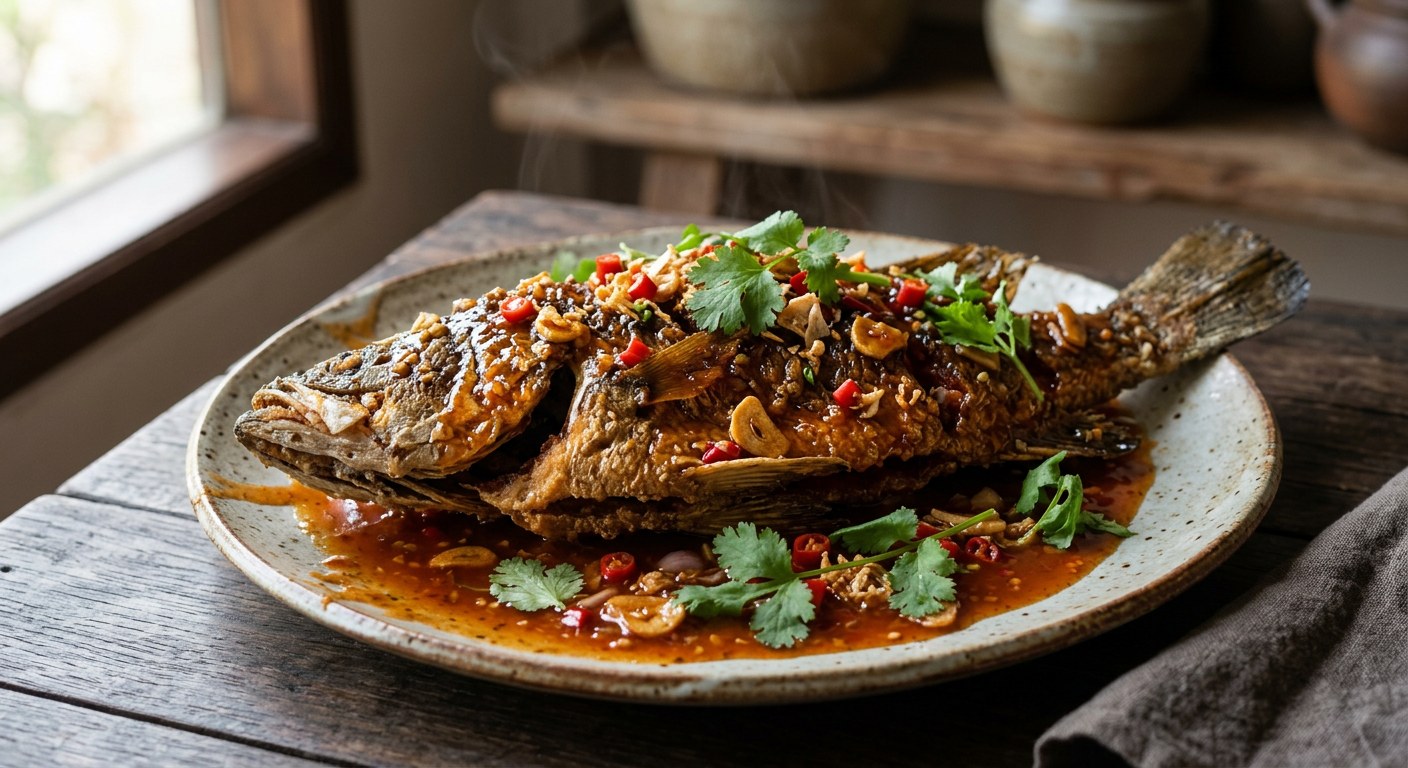
A whole fish deep-fried until the skin crackles, dressed at the table with a glossy hot sweet-sour chilli sauce — the four-cornered balance of sour, salty, sweet and heat that every Thai source calls สามรส.

Pla Rad Prik (ปลาราดพริก) — Whole Fried Fish with Sweet-Sour Chilli

The Sauce That Glazes

ปลาราดพริก means exactly what it does: pla (fish), rad (poured over), prik (chilli). The name hides the dish's real subject, which is the sauce. It is the Thai kitchen's most famous สามรส — the three flavours of sour, sweet and salty, backed by heat — built in the wok in minutes from garlic, coriander root and fresh chillies, then balanced with tamarind, fish sauce and palm sugar until it turns glossy and clings to the fish like a glaze.

The fish matters too, and every source treats it the same way: scale it, gut it, and บั้ง it — score the flesh with diagonal cuts on both sides — so it fries evenly and the sauce runs into the cuts instead of off the skin. A salt rub before it hits the oil keeps the skin from sticking and seasons as it cooks.

The dish spans the whole of Thai cooking, which is why the recipes disagree so cheerfully. The from-scratch school pounds fresh garlic, coriander root and chillies (Wongnai's home cook, TrueID's version of the same, and Pim's kitchen). The shortcut school starts from a bottle of sweet chilli dipping sauce and adjusts it with vinegar and fish sauce — Wongnai's editorial recipe says so outright, and Sanook's version was written for a weeknight. And Kapook's curry-paste pot swaps the fresh chilli for red curry paste entirely, making ปลาราดพริกแกง: same fish, same pour, different heat.

The Recipe (from-scratch three-flavour sauce, from Wongnai / TrueID / ครัวบ้านพิม)

ThaiEnglishAmount
ปลากะพง / ปลานิลWhole sea bass or tilapia, cleaned and scored1 (~800 g)
น้ำมันสำหรับทอดOil for deep-frying1 L
เกลือป่นSalt, for rubbing the fish½ tsp
กระเทียมGarlic, finely chopped or pounded3 tbsp
รากผักชีCoriander roots, finely chopped1 tbsp
พริกจินดาแดงRed bird's eye chillies, chopped or pounded5
น้ำตาลปี๊บPalm sugar2–3 tbsp
น้ำมะขามเปียกTamarind water2–3 tbsp
น้ำปลาFish sauce1½ tbsp
น้ำเปล่าWater½ cup
พริกชี้ฟ้าแดงRed spur chilli, sliced, for garnish1
ผักชีCoriander leaves, to garnishA few sprigs

The shortcut pot (Wongnai editorial): one cup of ready-made sweet chilli dipping sauce replaces the whole seasoning — fried with Thai garlic, coriander root and five red chillies, loosened with tamarind and water. The restaurant pot (ครัวบ้านพิม): 200 g palm sugar plus 50 g white sugar, half a cup of thick tamarind, a quarter cup of pickled garlic brine and a third of a cup of pickled garlic cloves — the brine doing the souring alongside the tamarind. The curry pot (Kapook): red curry paste pounded from dried chillies, shallots, garlic, galangal, lemongrass, kaffir lime zest and shrimp paste, fried and poured over the same crisp fish.

The Method

  1. The fish. Scale, gut and wash the fish, then score it with three or four diagonal cuts on each side — Pim insists on a sharp knife so the cuts are even and the fish fries flat. Rub with salt, inside and out, and pat dry with kitchen paper; TrueID is explicit that a wet fish spits and steams instead of crisping.
  2. The fry. Heat the oil well — TrueID fries over a very hot flame for four to six minutes on the first side, then less on the second — until the fish is golden and the scored edges crisp up. Lift out and drain. Wongnai's home cook dusts the fish with a little crispy-frying flour first if she wants the skin to shatter.
  3. The paste. Pound or chop the garlic, coriander roots and red chillies together. The coriander root is not negotiable — it is the three-flavour sauce's signature note, and Wongnai's editorial recipe names it as part of the Thai kitchen's สามเกลอ, the trio of garlic, coriander root and pepper.
  4. The sauce. Fry the paste in a tablespoon of oil over a low-medium flame until it smells sweet and garlicky, then add the tamarind water, fish sauce, palm sugar and water. Cook for four to five minutes, stirring, until the sugar has dissolved and the sauce is glossy — it should coat a spoon, not run off it. If it will not thicken, simmer a little longer; the sugar is the thickener.
  5. The balance, then the pour. Taste and adjust all four corners — sour, salty, sweet, hot — until no single one leads. Pour the sauce over the fish so it pools in the score marks, scatter coriander and sliced red spur chilli over the top, and serve at once with hot jasmine rice while the skin is still crisp.

Where Thai Sources Disagree

The sauce base. From scratch — garlic, coriander root and fresh chilli pounded and fried (Wongnai's home cook, TrueID, Pim) — or from a bottle: Wongnai's editorial recipe makes a cup of ready-made sweet chilli dipping sauce the main event, and Sanook's Ching does the same, adjusting with vinegar, sugar and fish sauce. Kapook leaves fresh chilli out altogether and fries red curry paste instead. All six still call the pour the same thing.

The sour. Tamarind water is the standard (Wongnai, TrueID, Pim, Wongnai editorial). Sanook reaches for white vinegar — sharper and faster. Pim doubles up, adding a quarter cup of pickled garlic brine, which sours and seasons at once. The restaurant version is noticeably more sour than the home version.

The sweet. From two tablespoons of palm sugar (Wongnai's home cook) to six (TrueID) — and Pim's restaurant kitchen uses 200 g of palm sugar plus 50 g of white sugar for a single fish. The sauce is sweet in every version; the disagreement is only about how much the diner can take.

The chillies. Red bird's eye chillies alone (Wongnai editorial, Pim), bird's eye plus red spur chilli (Wongnai's home cook), bird's eye plus spur chilli for garnish (TrueID). Sanook says add as many as you like — or none at all if you cannot take the heat.

The fish. Sea bass in the Wongnai and Sanook pots, tilapia in Pim's and TrueID's. Both work because both hold their shape in the oil; the sources argue about price and availability, not flavour.
How Western Versions Get It Wrong

UK Ingredient Notes

Sources

This recipe is translated from the following Thai-language sources. Where they disagree, we've said so.

1. Wongnai — "วิธีทำ ปลาราดพริก สามรส เมนูปลาทอดเข้มข้นครบรส" (the editorial shortcut pot; the three-amigos note) — wongnai.com

2. Wongnai — "ปลากระพงราดพริก" by นาง สุประวีณ์ รัตนะ (the from-scratch three-flavour pot; the recipe used here) — wongnai.com

3. ครัวบ้านพิม — "ปลานิลทอดราดพริกสามรส" (the restaurant pot; pickled garlic and its brine) — pim.in.th

4. TrueID Food — "ปลาทอด ราดพริกสามรส" (the blended-paste pot; the hot-oil frying times) — food.trueid.net

5. Sanook — "ปลากะพงทอดกรอบราดพริก 3 รสฉบับเร่งด่วน" by ชิ้ง (the vinegar and cornflour shortcut) — sanook.com

6. Kapook Cooking — "ปลาราดพริกแกง เมนูปลาทอดรสเผ็ด" (the curry-paste version, ปลาราดพริกแกง) — cooking.kapook.com

Johnny Tiger
Johnny researches and translates Thai recipes from Thai-language sources — chefs, restaurants and home cooks in Thailand — and publishes them with their sources cited. No westernised shortcuts, no invented steps.