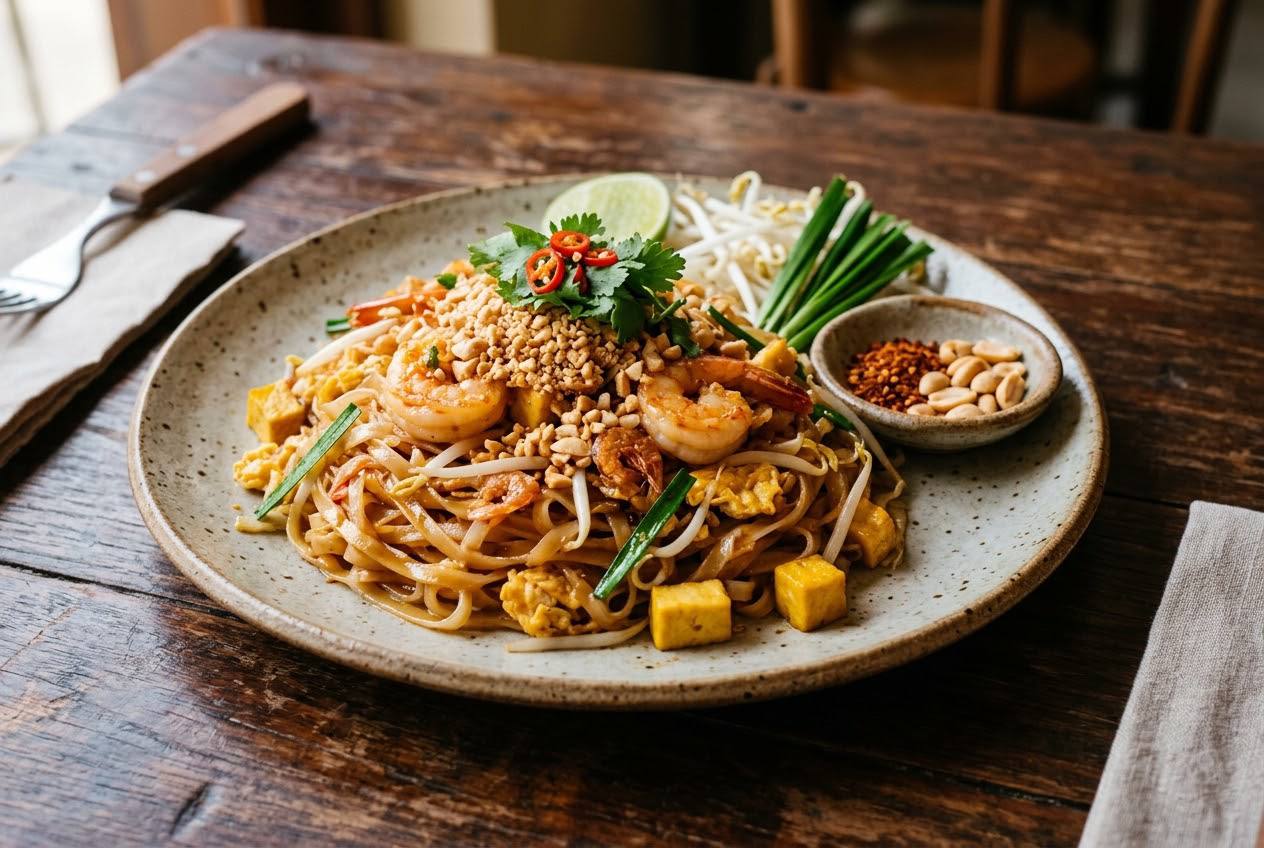
The dish the world knows — and the one it cooks worst. Tamarind, palm sugar and fish sauce in balance, sen chan noodles, dried shrimp and preserved radish. No ketchup, ever.
Pad thai is younger than you think — a World War II creation. With rice scarce, Prime Minister Phibun Songkhram's government campaigned to get the country eating noodles instead, and rebranded Chinese-style fried noodles as a national dish. The "Thai" touches were deliberate: pork — a Chinese ingredient — was swapped for dried shrimp, yellow tofu, lime, bean sprouts and banana blossom. A 2004 Thai rom-com even borrowed the name.
The dish's defenders take it seriously. On British TV's The F Word, Chef Chang of London's Blue Elephant told Gordon Ramsay to his face: "This is not pad thai at all. Pad thai must be sweet, sour, salty." — a clip Michelin's own article notes has 8.1 million views. Bib Gourmand chef Andy Yang of Phad Thai Fai Ta Lu goes further: "one of the hardest dishes in the world," five techniques in one plate — infusion, caramelisation, smoke, al-dente texture, glazing.
The south has its own century-old cousin: pad thai Chaiya, from Chaiya in Surat Thani — hotter, with a sauce built on dried chilli, shallot and shrimp paste fried in cracked coconut cream, simmered into the noodles over low heat. Chef Ice of Sorn, the world's first three-Michelin-star Thai restaurant, gave Michelin the full recipe. It's documented below.
| Thai | English | Amount |
|---|---|---|
| เส้นจันท์ (แช่น้ำ 10–15 นาที) | Sen chan rice noodles, soaked 10–15 min | 150–200 g |
| กุ้งสด | Fresh prawns, peeled and deveined | 5–8 |
| ไข่ไก่ | Eggs | 1–2 |
| เต้าหู้เหลือง | Yellow tofu, diced | 2–3 tbsp |
| ไชโป๊วหวาน | Sweet preserved radish, chopped | 1 tbsp |
| กุ้งแห้ง | Dried shrimp, rinsed | 1–2 tbsp |
| ถั่วงอก | Bean sprouts | 1 cup |
| ใบกุยช่าย | Garlic chives, cut into lengths | 2–3 stalks |
| หอมแดงซอย | Shallots, sliced | 1–2 tbsp |
| น้ำมันพืช | Vegetable oil | — |
| น้ำมะขามเปียก | Tamarind concentrate | 3–4 tbsp |
| น้ำตาลปี๊บ | Palm sugar | 2–3 tbsp |
| น้ำปลา | Good fish sauce | 2–3 tbsp |
| พริกป่น | Ground chilli | ½–1 tsp |
| ถั่วลิสงคั่วบด | Roasted peanuts, crushed — to finish | — |
| มะนาวซีก | Lime wedges — to serve | — |
The southern cousin, eaten in Chaiya, Surat Thani for over a century — hotter, richer, and saucy in a different way:
The sauce: 150 g dried chillies and 1 kg shallots pounded with flower salt, then 100 g shrimp paste; fried in 2 kg coconut cream that has been cooked until the oil cracks (the south calls it "ขี้โล้น" oil); seasoned with 1 kg coconut sugar, 250 g tamarind water (lime can substitute) and simmered until thick.
The stir-fry: oil and shallots, prawns and fresh sen chan noodles, a splash of stock, then the sauce — on low heat, stirred until the sauce absorbs into the noodles and they turn glossy. Egg at the pan edge, noodles folded over it, bean sprouts and chives in on high heat.
The sides: raw green mango strips, banana blossom, bean sprouts, chives, lone chillies (พริกลูกโดด), lime.
Classic tamarind sauce vs Chaiya's coconut-chilli-paste sauce. Different regions, both authentic, both called pad thai.
Banana blossom (หัวปลี) is a traditional side in the south and old Bangkok; most modern shops skip it.
Chilli in the sauce (some home recipes) vs chilli only on the side (the classic).
Pan. Chef Andy is relaxed: a teflon pan is fine if it's hot — the street-stall steel wok isn't the point, the heat control is.
The original had no tamarind. The first Phibun-era recipe used fermented orange juice for sourness; tamarind became standard later.
This recipe is translated from the following Thai-language sources. Where they disagree, we've said so.
1. Michelin Guide Thailand (3 Jul 2025) — "วิธีทำผัดไทยไชยาสูตร (ไม่) ลับ จานเด็ดระดับสามดาวมิชลินของร้านศรณ์" — Chef Ice, Sorn (3 stars) — guide.michelin.com
2. Michelin Guide Thailand (16 Jun 2020) — "เปิดสูตรลับร้านอาหาร: ทำผัดไทยอย่างไรให้อร่อยเด็ด" — Baan Phad Thai & Phad Thai Fai Ta Lu (both Bib Gourmand) — guide.michelin.com
3. Pantip thread 43607180 — "สูตรทำผัดไทยกุ้งสดแบบง่ายๆ" (the complete home recipe) — pantip.com
4. Pantip thread 43564848 — "ผัดไทยกุ้งสด โบราณๆ สูตรของคุณยาย" (grandmother's classic) — pantip.com