Recipe · Thailand & Laos · The Crispy Rice Salad

Nam Khao Tod (น้ำข้าวทอด)

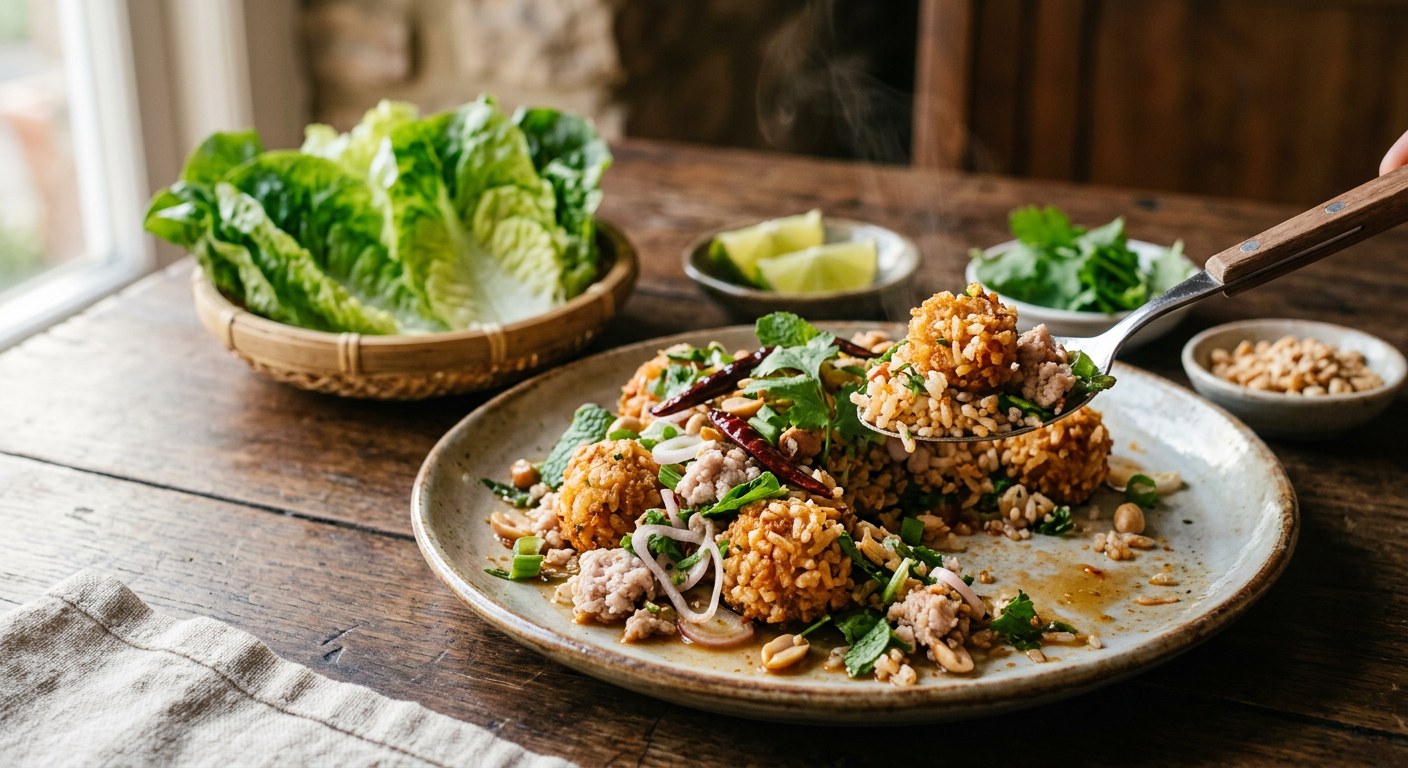
Curry-seasoned rice balls fried to a shell, broken apart while they're still warm and tossed with sour fermented pork, herbs and peanuts — Laos's answer to the salad, eaten wrapped in lettuce.

Nam Khao Tod — Lao-Isaan salad of deep-fried curry-seasoned rice balls, broken up and tossed with naem (fermented pork), minced

The Salad That Crossed the Mekong

Nam khao tod — น้ำข้าวทอด, "fried rice water" — is a Lao dish from Thadeua, the river town on the Lao bank of the Mekong, where it carries the name naem Thadeua. Thai cooks call it ยำแหนมข้าวทอด or แหนมคลุก (and sometimes just ข้าวทอดแหนม), and the technique travelled with it: leftover rice seasoned with red curry paste, grated coconut, kaffir lime leaves and egg, rolled into balls, fried until the outside is a shell, then broken up and tossed with naem — the sour fermented pork sausage that is the dish's other half — lime, fish sauce, chilli powder and a pile of herbs.

The Lao classic folds the cured pork straight into the rice ball before frying, and kitchen blogger ครัวบ้านพิม records exactly that: naem blitzed into the rice with the curry paste, fried as one thing. The Isaan table more often keeps them apart — Wongnai's recipe mixes the naem into the salad at the last minute, breaking the hot rice balls over it so the crispness survives the toss. Either way the rice is the engine: Kapook's home cook, who drove round the local markets hunting for the dish and came home empty-handed, found that frying is what makes it — the balls puffed in hot oil until crisp outside and soft inside.

It is eaten as a wrap: a lettuce leaf filled with a spoon of the salad, herbs on top, and a fried dried chilli to finish — the plate of fresh vegetables is not garnish, it is the cutlery.
The Recipe (home version, from Wongnai)

ThaiEnglishAmount
ข้าวสวยRice (cooked)3 cups
มะพร้าวขูดขาวGrated coconut½ cup
ไข่ไก่Egg1
พริกแกงเผ็ดRed curry paste2 tbsp
น้ำปลาFish sauce1 tbsp
น้ำตาลทรายSugar1 tsp
ใบมะกรูดซอยKaffir lime leaves, sliced1 tbsp
น้ำสะอาดWater½ cup
แป้งทอดกรอบCrisp frying flour½ cup
น้ำมันพืชVegetable oil (for frying)—
แหนมสดNaem (fermented pork)50 g
หมูสับMinced pork100 g
หนังหมูซอยPork skin, sliced¼ cup
น้ำปลาFish sauce1 tbsp
น้ำมะนาวLime juice1 tbsp
พริกป่นChilli powder1 tbsp
ขิงซอยGinger, julienned2 tbsp
หอมแดงซอยShallots, sliced2 tbsp
พริกทอดFried dried chillies4
ต้นหอมSpring onion2 tbsp
ผักชีCoriander2 tbsp
ถั่วลิสงทอดFried peanuts2 tbsp

The Lao-style ball (ครัวบ้านพิม): the same rice and curry paste, but 1 cup of diced naem goes into the rice before shaping — fried as one piece, served with diced ginger, shallots, peanuts, chillies and lime over cold lettuce and betel leaves. The from-scratch naem (Aroifin): 500 g lean pork blitzed fine with 100 g cooked pork skin, 50 g pounded garlic, 1 tbsp salt, 1 tbsp seasoning powder and 2 tbsp cooked sticky rice, bagged with fresh chillies, air pressed out, left 1–2 days at room temperature.

The Method

  1. The rice balls. Mix the cooked rice with the red curry paste and the egg, season with fish sauce and sugar, then knead in the sliced kaffir lime leaves and shape into balls — Wongnai's order, and the paste must be worked in evenly or the balls fry patchy.
  2. The batter. Stir the crisp frying flour into the water. Aroifin uses very cold water for the same flour; ครัวบ้านพิม's soft-shell alternative is rice flour, egg and น้ำปูนใส — limewater — for a thin coat.
  3. The fry. Deep-fry the battered balls in hot oil until golden all over — ครัวบ้านพิม wants the oil at least two inches deep so the balls turn evenly — then lift out and drain.
  4. The break. While they are still warm, crush the fried balls into chunks in a bowl and add the naem, pork skin and minced pork. Season with lime juice, fish sauce and chilli powder; Wongnai crushes only until just broken, so the shells stay crisp.
  5. The toss. Add the shallots, ginger, spring onion, coriander, peanuts and fried chillies and toss once more. Serve with fresh vegetables — lettuce, and betel leaves if you can get them — and let each eater wrap their own spoonful.

Where Thai Sources Disagree

Naem in the ball or in the salad. ครัวบ้านพิม puts diced naem inside the rice before frying — the Lao nam khao form. Wongnai and Aroifin fry plain curry rice balls and mix the naem in at the salad stage, which is the Isaan yam style you'll meet in most Thai restaurants.

Coconut. Wongnai and Aroifin season the rice with grated coconut (Wongnai uses grated white coconut, Aroifin กากมะพร้าวขูด). ครัวบ้านพิม and the Wongnai user recipe for the balls leave it out entirely.

The batter. Wongnai dips in crisp frying flour mixed with water; Aroifin insists the water be ice-cold; ครัวบ้านพิม offers two coats — a soft one of rice flour, egg and limewater, or crisp frying flour with cold water at 1:2 for a hard shell — and Kapook's cook skips the dip altogether, mixing the flour into the rice dough.

Pork skin or minced pork. Wongnai uses both pork skin and minced pork. Kapook's home cook refuses pork skin ("just naem and rice, no picking skin out") and blanches minced pork instead; ครัวบ้านพิม notes the same swap.

The rice. Aroifin and ครัวบ้านพิม both warn against jasmine rice — use a hard, dry rice or the fried balls turn soggy and soft. Wongnai and Kapook don't specify.

How Western Versions Get It Wrong

UK Ingredient Notes

Sources

This recipe is translated from the following Thai-language sources. Where they disagree, we've said so.

1. Wongnai — "วิธีทำ 'ยำแหนมข้าวทอด' เมนูอาหารอีสานครบเครื่อง รสแซ่บอีหลี" by แม่หญิงแพรวา (the recipe used here) — wongnai.com

2. Aroifin — "วิธีทำ แหนมคลุก ง่าย ๆ ที่บ้าน พร้อมสูตร แหนมหมู – ข้าวทอด กรอบอร่อย" (the from-scratch naem and the cold-water batter) — aroifin.com

3. ครัวบ้านพิม — "ข้าวทอดแหนม" by พิม (the Lao-style ball with naem inside) — pim.in.th

4. Kapook — "ยำแหนมข้าวทอดใส่หมูสับ เผ็ดเปรี้ยวพร้อมวิธีทำข้าวทอด" from Pantip member bangbuatong60d (the pork-skin-free version and the hunt for the dish) — cooking.kapook.com

5. Wongnai (user recipe) — "ข้าวทอด สำหรับทำยำแหนมข้าวทอด" by guneweenz (the bare rice-ball component) — wongnai.com

Johnny Tiger
Johnny researches and translates Thai recipes from Thai-language sources — chefs, restaurants and home cooks in Thailand — and publishes them with their sources cited. No westernised shortcuts, no invented steps.