Recipe · Thailand · The Salad Songkhla Eats for Breakfast
Khao Yam (ข้าวยำ)
The south's rice salad — butterfly-pea rice under a pile of shredded herbs, roasted coconut and dried shrimp, brought together by budu sauce.
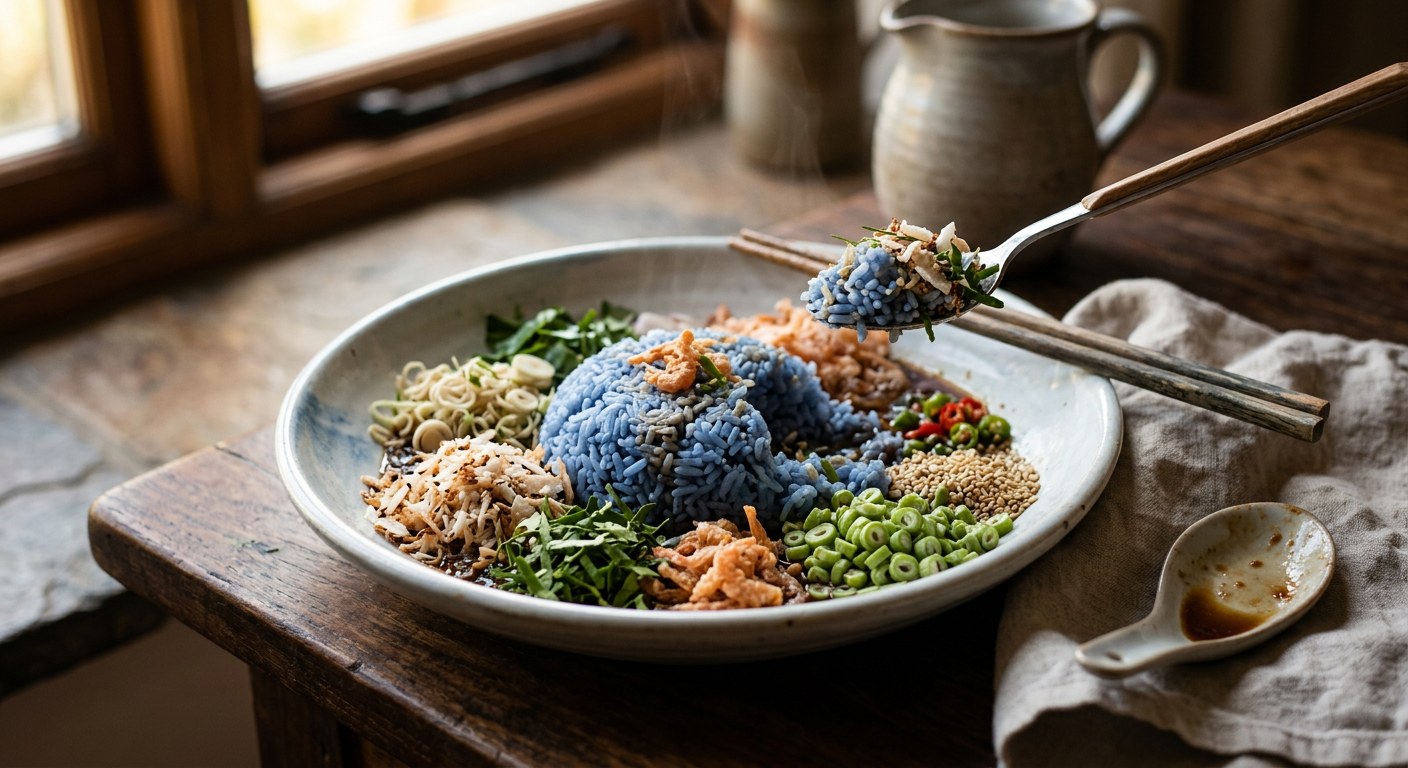
The south's rice salad — butterfly-pea rice under a pile of shredded herbs, roasted coconut and dried shrimp, brought together by budu sauce.
ข้าวยำ is the southern Thai dish Wongnai introduces by telling you to forget the Korean rice bowl: rice, raw vegetables and a sauce to bind them, but built from the herbs of the south and dressed with nam budu — fermented anchovy sauce, the region's answer to pla ra — simmered with lemongrass, galangal and kaffir lime leaves until it smells like the market at dawn.
The vegetable set is flexible by design. Wongnai's Poondang says it plainly: whatever local herbs are on hand, sliced fine so the sauce clings. Cha phlu leaves, lemongrass and kaffir lime are the constants; gotu kola, torch ginger flowers, sator beans and sour mango come and go with the season. The Samphaotong curry-paste house of Satun lists the dish as a breakfast, eaten with boiled egg, pea aubergine and cashew leaf shoots.
Then there's the rice. Poondang crushes fresh butterfly-pea flowers into the cooking water for a blue bowl; the food-science blogger at Mccview steams his with butterfly-pea and turmeric waters for blue and yellow halves; Kapook's Songkhla cook doesn't bother — plain rice, because the spectacle in her version is elsewhere: rice vermicelli stir-fried with dark soy and broken rice crackers, so the sauce has something to cling to and something to crunch.
| Thai | English | Amount |
|---|---|---|
| ข้าวสารหอมมะลิ | Jasmine rice | 1 cup |
| น้ำเปล่า | Water | 1¼ cups |
| ดอกอัญชันสด | Fresh butterfly pea flowers | 4–5 |
| น้ำบูดู | Budu sauce | 150 ml |
| ตะไคร้หั่น | Lemongrass, cut | 2 stalks |
| ใบมะกรูดฉีก | Kaffir lime leaves, torn | 5 |
| ข่าแก่หั่นแว่น | Galangal, sliced | 3 slices |
| หอมแดงบุบ | Shallots, bruised | 4 |
| น้ำตาลมะพร้าว | Palm sugar | 2 tbsp |
| ปลาอินทรีเค็ม | Salted king mackerel (in the sauce) | 1 piece |
| กุ้งแห้งโขลก | Pounded dried shrimp | 1 cup |
| มะพร้าวคั่ว | Roasted coconut | 1 cup |
| พริกแห้งป่น | Dried chilli powder | ¼ cup |
| ใบชะพลูซอย | Cha phlu leaves, sliced | 2 cups |
| ใบมะกรูดซอย | Kaffir lime leaves, sliced | ¼ cup |
| ตะไคร้ซอย | Lemongrass, sliced | ¼ cup |
| ถั่วงอก | Bean sprouts | 1 cup |
| ถั่วฝักยาวซอย | Long beans, sliced | 1 cup |
| กะหล่ำปลีม่วงซอย | Red cabbage, sliced | ½ cup |
| สะตอซอย | Sator beans, sliced | ¼ cup |
| มะนาว | Lime | 1 |
The weighed version (Mccview): 200 g rice, 20 g each dried shrimp and roasted coconut, 60 g pomelo, 40 g sour mango, 40 g each bean sprouts and cucumber, 30 g long beans, 20 g lemongrass — with a 240 g budu sauce simmered with 120 g palm sugar, shallots, lemongrass and galangal. The health swap (Wongnai's ปากน้ำเมี่ยน): brown jasmine rice and a sweet shrimp-paste sauce (1 tbsp kapi, 90 g fried salted mackerel, palm and white sugar, makrut juice) instead of budu.
The sauce. Budu, simmered and strained, is the classic — but Wongnai's health version swaps in a sweet shrimp-paste sauce on the grounds that budu "may not be familiar to everyone", and Kapook's Songkhla cook simply buys ready-made nam khao yam (the Sinthorn Adulyaphon brand, from Songkhla itself).
The rice. Butterfly-pea blue (Poondang), blue-and-yellow turmeric stripes (Mccview), plain white (Kapook), or brown jasmine for the health version. The herb salad is the dish; the rice colour is a flourish.
Fish in the sauce. Poondang melts a piece of good salted king mackerel into the budu as it reduces — "both thickness and depth" — and the health version does the same with fried mackerel in its shrimp-paste sauce. Mccview's budu is aromatics and palm sugar only.
Noodles and crackers. Only the Songkhla version adds sen mee stir-fried with dark soy and broken fried rice crackers — the sauce clings to the noodles, the crackers crunch. Everywhere else it's rice and herbs alone.
The vegetable set. Cha phlu, lemongrass and kaffir lime leaf are everywhere; gotu kola, wing beans, torch ginger flowers, sator, pomelo, cucumber and sour mango are local choices. No two southern provinces serve the same bowl.
This recipe is translated from the following Thai-language sources. Where they disagree, we've said so.
1. Wongnai — "วิธีทำ!! 'ข้าวยำปักษ์ใต้' เมนูอาหารใต้ สูตรเด็ดหรอยอย่างแรง!" by ปูนแดง Poondang (the recipe used here) — wongnai.com
2. Mccview — "ข้าวยำปักษ์ใต้ (พร้อมน้ำบูดู)" by ManCanCook (the weighed version) — mccview.com
3. Kapook — "ข้าวยำปักษ์ใต้ หรอยอย่างแรง ไม่อ้วนด้วยนะน้องสาว" by มูมมามตามตุ๊ด (the Songkhla version with noodles and crackers) — cooking.kapook.com
4. สำเภาทอง (Samphaotong, Satun) — "แนะนำเมนูอาหารเช้า 'ข้าวยำปักษ์ใต้' อาหารเพื่อสุขภาพ" — samphaotong.com
5. Wongnai — "ข้าวยำสมุนไพรทรงเครื่องน้ำกะปิหวาน" by ปากน้ำเมี่ยน (the health version with sweet shrimp-paste sauce) — wongnai.com