Recipe · Thailand · The Snack Built From Leftover Rice

Khao Tang Na Tang (ข้าวตังหน้าตั้ง)

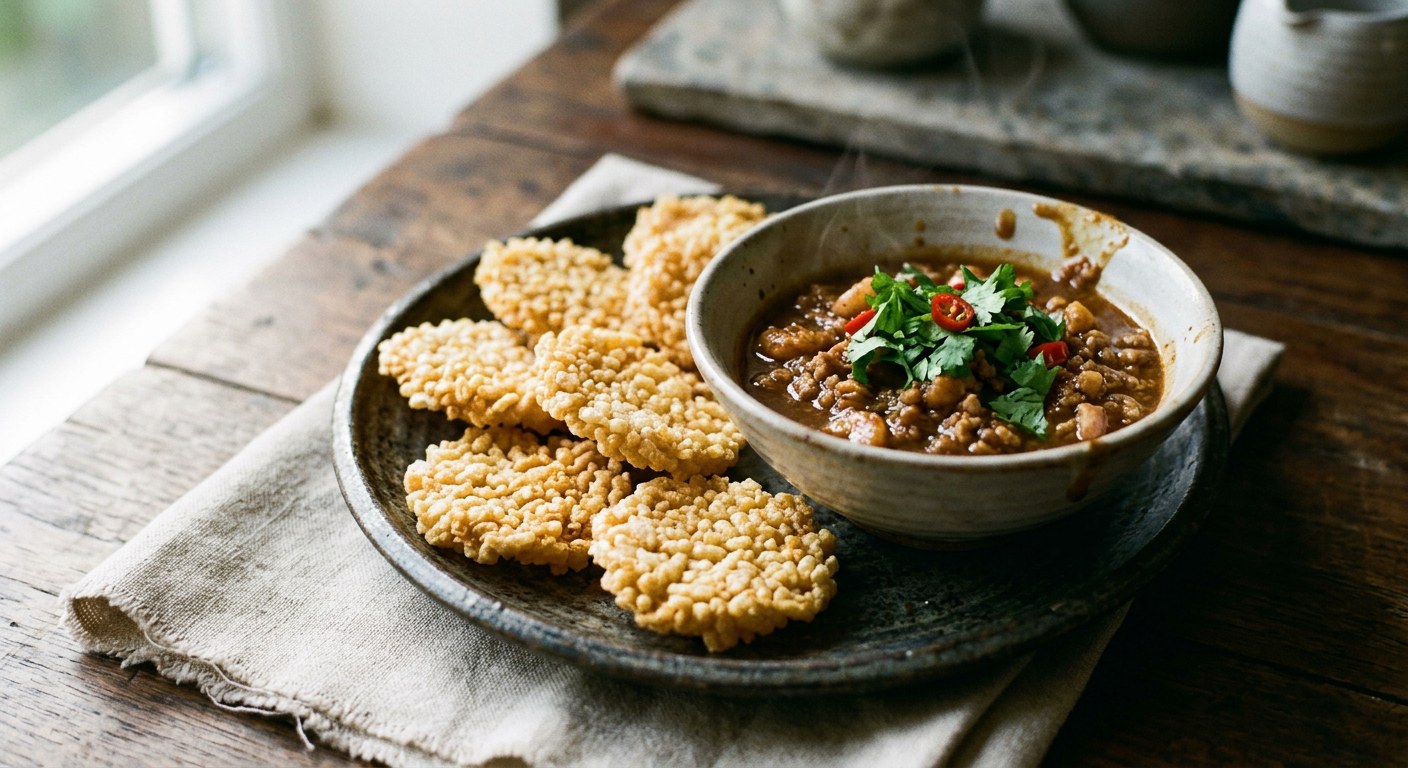
The starter of thrift: the rice crust from the bottom of the pot, sun-dried and fried into a shattering puff, carrying a sweet, salty, nutty crown of pork and shrimp simmered in cracked coconut milk.

Khao Tang Na Tang (ข้าวตังหน้าตั้ง) — Crisp Rice Crackers with Pork Shrimp Coconut

The Snack Built From Leftover Rice

The dish begins where most cooking throws something away. ข้าวตัง — khao tang — is the crust of rice that sticks to the bottom of the pot: in the wood-fire kitchens of the recipe writers' grandmothers, nothing went to waste, so the scraped crust was pressed into discs and dried in the sun. Pim's recipe opens with exactly this memory — the pot on the firewood stove, the stuck rice scraped out and dried for the children's snacks — and Bloggang's monnira tells the same story, then fries it to a puff. Fried, the dried crust balloons into a light, airy cracker that shatters between the teeth; the old rice becomes the crispest thing in Thai cooking.

What turns the cracker into a dish is หน้าตั้ง (na tang) — the topping. The name follows the serving: the dip is spooned onto (หน้า) the cracker, thick enough to sit there (ตั้ง) without sliding off. Under it is a full little curry in miniature: the three friends — coriander root, garlic, white pepper — pounded and fried in coconut milk that has first been cooked until it cracks its oil, then minced pork and shrimp, then the Thai trinity of palm sugar, fish sauce and tamarind, finished with shallots and ground roasted peanuts. Wongnai's Tuangrath Kamolwatin calls it an easy dish with a long ingredient list, and notes the quiet test of a good cook: balance the three tastes so that not one shouts above the others.

Kapook's recipe, from the pages of Gourmet & Cuisine magazine, describes it as the snack grandparents grew up with and younger generations barely know — and the home cooks who still make it agree it has never been a restaurant dish. It is party food of the household: crackers fried at the last minute, dip warm in a bowl, everyone spooning for themselves.

The Recipe (home version, from Kapook / Wongnai / Bloggang)

ThaiEnglishAmount
ข้าวตังแผ่นDried rice cakes (raw discs)10–20 pieces
หมูสับMinced pork250 g
กุ้งสับMinced shrimp150 g
กะทิCoconut milk2 cups
รากผักชีCoriander roots3
กระเทียมGarlic2 tbsp
พริกไทยเม็ดWhite peppercorns1 tsp
พริกแห้งเม็ดใหญ่Large dried chillies, soaked and seeded (optional, for colour)1–2
น้ำตาลปี๊บPalm sugar3–4 tbsp
น้ำปลาFish sauce2–4 tbsp
น้ำมะขามเปียกTamarind water2–3 tbsp
ถั่วลิสงคั่วบดRoasted peanuts, ground¼–⅓ cup
หอมแดงซอยShallots, thinly sliced⅓ cup
น้ำมันพืชVegetable oil, for fryingas needed

The other pots: Phol Food Mafia keeps it lean — 100 g pork, 100 g shrimp, one cup of coconut milk, a single dried chilli, 3 tbsp peanuts, and insists the dip must reduce until it can hold itself on the cracker. Wongnai's Tuangrath uses 300 g pork to 200 g shrimp, three cups of coconut milk, and a teaspoon of seasoning powder in place of extra fish sauce, and recommends any leftover dip over blanched rice vermicelli. Pim's home version is 150 g pork, 100 g shrimp, one box of Amphawa coconut milk, a quarter-cup of onions fried with the paste, and chicken breast as the swap for anyone who does not eat pork. Bloggang's monnira cooks by feel — fish sauce and palm sugar to taste, three big dried chillies for colour, and both thin and thick shop-bought discs. Kapook's tip from the magazine kitchen: pound one soaked dried chilli and one shallot into the paste for colour and perfume, and finish with chilli oil if you like it hot.

The Method

  1. The paste. Pound the coriander roots, garlic and white peppercorns — the สามเกลอ — with the soaked, seeded dried chillies if you want the deeper colour. Bloggang pounds the peppercorns first, then the chillies, roots and garlic, with a pinch of salt to stop the mortar slipping.
  2. The crack. Heat about a third of the coconut milk in a pot until it breaks — กะทิแตกมัน, the oil splitting out and beading on the surface. This is the step every source shares: the paste must fry in cracked coconut, not boil in milk. Then in goes the paste, stirred until the kitchen smells of garlic and pepper.
  3. The meat. Add the minced pork and shrimp and work them with the spatula as they cook, so they stay loose and granular instead of clumping into balls. Wongnai adds diced onion here and fries it translucent first; the others go straight in with the meat.
  4. The season. Pour in the remaining coconut milk and season with palm sugar, fish sauce and tamarind water. Pim's rule is the dish's rule: three tastes — sour, sweet, salty — all present, none dominant; if it runs too intense, a little more coconut milk will settle it.
  5. The finish. Stir in the sliced shallots and the ground roasted peanuts and simmer until the dip thickens — Phol Food Mafia's test is that it must be able to sit on the cracker without running off. Warm, glossy and slightly chunky is the target.
  6. The crackers. Fry the dried rice cakes in plenty of hot oil, pressing them under the surface now and then so they puff evenly, until golden on both sides — Bloggang warns the discs curl as they fry; a nudge with the spatula settles them. Drain on paper, and fry only what you will eat: the crisp dies within the hour.
  7. The serve. Spoon the warm na tang over the crackers and crown each with a few coriander leaves and slivers of red spur chilli — or set the bowl of dip beside the plate and let everyone serve themselves, as Bloggang's table does.

Where Thai Sources Disagree

The tamarind. Kapook, Wongnai, Pim and Phol Food Mafia all season the dip with tamarind water — the third taste alongside palm sugar and fish sauce. Bloggang's monnira seasons with fish sauce and palm sugar alone and lets the dip ride on sweet and salty. Her dip is the older, simpler line; the tamarind version is today's majority.

The dried chillies. Bloggang pounds in three big soaked chillies, Wongnai two (explicitly for colour, not heat), Phol Food Mafia one small one. Kapook makes them optional — the magazine's tip adds one chilli and one shallot to the paste. Pim leaves them out entirely. Nobody's version is meant to be properly hot; the chilli is for colour and depth.

Onion or not. Wongnai and Pim fry a diced cooking onion with the paste before the meat goes in. Kapook, Bloggang and Phol Food Mafia skip it, trusting shallots alone — added only at the end, sliced, so they keep a little bite.

The order of the crack. Wongnai, Bloggang, Pim and Phol all cook the coconut milk until it splits, then fry the paste in it. Kapook's Gourmet & Cuisine recipe does the opposite: the paste is worked into the raw pork and shrimp, then hot coconut milk is gradually stirred into the mixture before the pot goes on to boil. The destination is the same dip; the road differs.

The ratio of pork to shrimp. Bloggang and Phol Food Mafia run one-to-one; Wongnai and Pim lean on the pork (three to two); Kapook is five to three. All agree the shrimp is the luxury that lifts the pork — how much luxury is a question of budget.

The seasoning salt. Wongnai's Tuangrath seasons with salt and a teaspoon of Knorr seasoning powder rather than more fish sauce — the sponsored-recipe shortcut — while everyone else builds saltiness on fish sauce alone. The two roads taste noticeably different; fish sauce is the older one.

The crackers. Pim and Bloggang both know the true version — leftover rice pressed thin and dried two days in the sun — and both also confess to buying ready-made discs, thin or thick, round or square, from the grocer. The bought discs fry the same; only the memory is different.
How Western Versions Get It Wrong

UK Ingredient Notes

Sources

This recipe is translated from the following Thai-language sources. Where they disagree, we've said so.

1. Kapook Cooking — "ข้าวตังหน้าตั้ง ของว่างไทยโบราณกรอบนานพ่วงสูตรน้ำจิ้ม", from Gourmet & Cuisine magazine (the base recipe used here) — cooking.kapook.com

2. Wongnai — "ข้าวตังหน้าตั้ง" by Tuangrath Kamolwatin (the three-cup coconut milk pot; Knorr seasoning) — wongnai.com

3. Phol Food Mafia — "Savory Rice Crackers (ข้าวตังหน้าตั้ง)" (the lean 100/100 g version; the thick-enough-to-sit test) — pholfoodmafia.com

4. Pim.in.th — "ข้าวตังหน้าตั้ง" (the wood-fire childhood story; how to make the rice discs at home) — pim.in.th

5. Bloggang — "ข้าวตังหน้าตั้ง" by monnira (the no-tamarind dip; the frying notes) — bloggang.com

Johnny Tiger
Johnny researches and translates Thai recipes from Thai-language sources — chefs, restaurants and home cooks in Thailand — and publishes them with their sources cited. No westernised shortcuts, no invented steps.