Recipe · Thailand · The Dumpling Steamed On The Pot's Mouth

Khao Kriap Pak Moh (ข้าวเกรียบปากหม้อ)

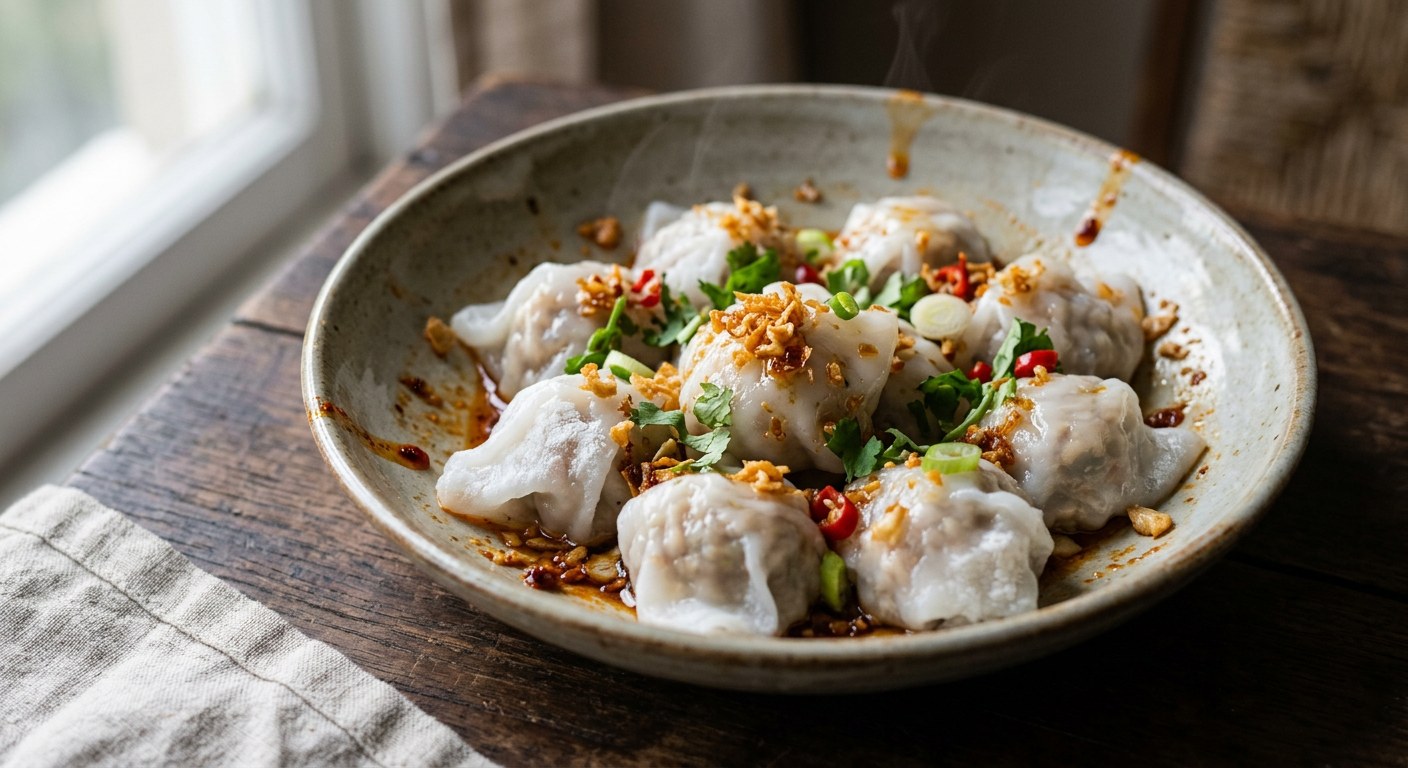
A batter-thin rice skin steamed on a cloth stretched over the pot, folded in one move around a sweet-savoury pork, radish and peanut filling — the other half of every market dumpling stall in Thailand.

Khao Kriap Pak Moh (ข้าวเกรียบปากหม้อ) — Steamed Rice-Skin Dumplings with Pork

The Dumpling That Names Its Steamer

ข้าวเกรียบปากหม้อ takes its name from where it is cooked: ปากหม้อ is the mouth of the pot, and the dish is made by stretching a white cloth tight across that mouth and steaming wafer-thin rounds of rice batter on it — ข้าวเกรียบ is the "rice crisp" the translucent skin is named after, even though the finished skin is soft, not crisp. The vendor's rhythm never changes: ladle, spread, cover, and the moment the skin turns glass-clear, a ball of filling goes in the middle and the skin is folded up and over with one scrape of the spatula.

It is the permanent stall-mate of sakoo sai moo, and the two usually share a filling. Kapook's recipe runs the same sweet-savoury pork — palm sugar, ground peanuts, radish — through both dishes, and notes that this is why the pair is always sold together: one filling, two wrappers, one stall. TrueID pitches the dish the other way round, as a money-maker — the same page teaches sakoo sai moo first, then this, as the two halves of a proper snack business.

The skin is the skill. Wongnai's vendor advice is all about the cloth: use white muslin, stretch it as tight as it will go, because the batter will not spread on a slack cloth — and sieve the batter twice so no lumps of raw flour spot the skins. The filling, every source agrees, must be cold before it touches the skin, or the steam from a warm filling turns the wrapper to glue in your hands.
The Recipe (home version, from Aroifin / Kapook)

ThaiEnglishAmount
แป้งข้าวเจ้าRice flour2 cups
แป้งมันสำปะหลังTapioca flour1 cup
แป้งเท้ายายม่อมArrowroot flour1/2 cup
น้ำเปล่าWater4 cups
หมูสับMinced pork150 g
ไชโป๊หวานSweet pickled radish, finely chopped150 g
ถั่วลิสงคั่วRoasted peanuts100 g
หอมแดงShallots80 g
กระเทียมGarlic30 g
รากผักชีCoriander root15 g
พริกไทยเม็ดWhite peppercorns1/2 tbsp
น้ำตาลปี๊บPalm sugar2 1/2 tbsp
ซีอิ๊วขาวLight soy sauce1/2 tbsp
น้ำมันพืชVegetable oil2–3 tbsp
กระเทียมเจียว, ผักสดFried garlic and garlic oil, lettuce, fresh chillies, corianderto serve

The market-scale batch (TrueID): 250 g minced pork, 200 g roasted peanuts, 200 g sweet radish, palm sugar, light soy and a half teaspoon of salt — plus 300 g coconut cream thickened with rice flour, poured over the top. The classic thin skin (Kapook / Wongnai): 1 cup rice flour with just 2 tablespoons tapioca flour and 1 tablespoon arrowroot to 3 cups water — the old thin, translucent style. The coloured skins (Wongnai): swap part of the water for pandan water for green skins and butterfly pea water for blue, the way market stalls lay out white, green and blue dumplings side by side. The vegetarian stall (Krua): firm tofu in place of the pork, same radish, peanuts and seasoning.

The Method

  1. The filling. Pound peppercorns, coriander root and garlic to a paste, fry it in oil until it smells, then add the pork and break it up as it cooks — TrueID cooks the sugar into the pan early so it melts into the meat rather than sitting on it. Add the shallots and sweet radish, season with palm sugar and light soy, and fry until the filling is dry. Peanuts go in last, off the heat. Spread it out and let it cool completely — Wongnai is explicit that a warm filling steams the skins before they are wrapped.
  2. The batter. Whisk the rice flour, tapioca flour and arrowroot flour with the water until smooth. Aroifin rests the batter for 20 to 30 minutes so the flours absorb the water fully — rested batter makes a skin that steams even and does not tear — and Wongnai sieves it twice against lumps. Stir before every ladle, because the mixed flours settle.
  3. The cloth. Stretch a clean white cloth over the mouth of a wide pot of boiling water and tie it drum-tight. Both Wongnai and Kapook name this as the step that decides everything: on a slack cloth the batter puddles, the skins steam thick, and nothing peels off clean.
  4. The skins. Ladle a thin round of batter onto the cloth and spread it into a circle, cover the pot, and steam until the skin turns translucent — a matter of seconds. Aroifin's tip is a medium-high flame: hot steam sets the skin fast, and a fast-set skin is thin, clear and peels off the cloth in one piece.
  5. The fold. Drop a small ball of filling in the centre of each cooked skin, then fold the skin up and over it with a spatula — one scrape, one parcel, the vendor's move. Lift onto a tray brushed with garlic oil.
  6. The serve. Brush the tops with garlic oil and shower with fried garlic. Serve warm with lettuce leaves, fresh bird's eye chillies and coriander — wrap a dumpling in lettuce with a sliver of chilli, the way the stalls hand them over. TrueID's stall version adds a ladle of warm, lightly salted coconut cream over the top.

Where Thai Sources Disagree

The coconut cream topping. TrueID finishes the dumplings with น้ำราดกะทิ — coconut cream thickened with a spoon of rice flour and a pinch of salt, warmed and poured over. Kapook, Wongnai and Aroifin use nothing but garlic oil and fried garlic. Both are genuine stall styles: the plain version is the classic Bangkok market one, the coconut-cream version a richer regional take — TrueID frames it as the version that sells.

The skin ratio. Kapook and Wongnai make the old thin skin: a cup of rice flour stiffened with only a spoon or two each of tapioca and arrowroot flours. Aroifin goes a full cup of tapioca flour to two cups of rice — nearly a third of the batter — for a thicker, springier skin that holds a bigger lump of filling, and says outright that less water gives you the thick-skin style. Same dish, two generations of skin.

Coloured skins. Wongnai and TrueID colour part of the batter with pandan water (green) and butterfly pea water (blue); Kapook and Aroifin make only white. The coloured versions are pure market style — the stalls lay out the three colours together, and the flavour of the skin is unchanged.

The filling's radish. All five sources use sweet pickled radish (ไชโป๊หวาน) here — unlike sakoo sai moo, where the sources split between sweet and salted. On this dish the sources agree, which is the rare thing worth noting itself.

How Western Versions Get It Wrong

UK Ingredient Notes

Sources

This recipe is translated from the following Thai-language sources. Where they disagree, we've said so.

1. Aroifin — "วิธีทำ ข้าวเกรียบปากหม้อ ไส้หมูแน่น ๆ แป้งนุ่มเด้ง" (the recipe used here; the springy-skin ratio and the rest-and-stir batter) — aroifin.com

2. Kapook Cooking — "ข้าวเกรียบปากหม้อ สาคูไส้หมู อาหารว่างแบบไทย ๆ ยอดนิยม" (the classic thin skin and the shared filling with sakoo sai moo) — cooking.kapook.com

3. Wongnai — "แจกสูตรฟรี ข้าวเกรียบปากหม้อ แป้งเหนียวนุ่มสูตรโบราณ" (the vendor's cloth technique, the sieved batter, pandan and butterfly pea skins) — wongnai.com

4. TrueID Food — "สูตรทำ ข้าวเกรียบปากหม้อ เมนูสร้างอาชีพ" (the market-scale batch; the coconut cream topping) — food.trueid.net

5. Krua.co — "ข้าวเกรียบปากหม้อไทย" (the vegetarian stall version, tofu for pork) — krua.co

Johnny Tiger
Johnny researches and translates Thai recipes from Thai-language sources — chefs, restaurants and home cooks in Thailand — and publishes them with their sources cited. No westernised shortcuts, no invented steps.