Fermented fish innards simmered into a broth, a fresh pounded southern paste, grilled fish and vegetables — murky, hot, salty, and fiercely defended by everyone who grew up with it.
แกงไตปลา is named for its engine: tai pla, the fermented guts of fish — the stomach, not the kidney the literal translation implies — salted and left to do its dark work in a bottle. Southerners also call it แกงพุงปลา, the fish-belly curry. The smell divides the country before the taste ever gets a vote, and in 2025 TasteAtlas ranked it ninth on its list of the world's 100 worst-rated foods — to which Thai social media answered with the #saveแกงไตปลา campaign and a national show of loyalty, as Kapook records.
The technique is a two-stage build. First the tai pla is boiled with aromatics and strained — Wongnai simmers it with shallots, galangal, lemongrass, kaffir leaves and tamarind; TrueID's selling version adds a rule of its own: leave the pot alone for five to ten minutes, do not stir, or the broth clouds. Then the fresh paste — dried chillies pounded first, peppercorns pounded separately and added last — goes into the broth with the vegetables, hard ones first, long beans dead last so they keep their crunch.
Mahidol's nutritionists describe the two schools: the classic is the clear version with no coconut milk — the one southerners actually favour — while the kathi version exists but adds fat to a curry already salty and hot enough to make the institute warn you to eat the solids and go easy on the broth. And TrueID's second recipe fries the whole idea down into kaeng tai pla haeng: the dry version, the same paste and tai pla water cooked with palm sugar and cashews until it is a sticky, spoonable concentrate.
| Thai | English | Amount |
|---|---|---|
| พริกแห้ง | Dried chillies | 20 |
| กระเทียมไทย | Garlic | 1 head |
| หอมแดง | Shallots | 2 heads |
| ตะไคร้สับ | Lemongrass, chopped | 1 stalk |
| ผิวมะกรูด | Kaffir lime zest | 1 lime |
| ขมิ้น | Turmeric | 1 knob |
| พริกไทยขาว | White peppercorns | 1 tsp |
| พริกไทยดำ | Black peppercorns | 1 tsp |
| ไตปลาทู | Tai pla (fermented fish innards) | ½ cup |
| น้ำเปล่า | Water | 2–3 cups |
| หอมแดง | Shallots | 2 heads |
| ข่า | Galangal | 1 knob |
| ตะไคร้ | Lemongrass | 2 stalks |
| ใบมะกรูดฉีก | Kaffir lime leaves, torn | 4 leaves |
| น้ำมะขามเปียก | Tamarind water | ½ cup |
| กะปิ | Shrimp paste | ½ tbsp |
| เนื้อปลาทูย่าง | Grilled pla thoo, flaked | 1 cup |
| หน่อไม้ | Bamboo shoots | ½ cup |
| มะเขือเปราะ | Thai round aubergine | ½ cup |
| ถั่วฝักยาวหั่นท่อน | Long beans, cut | ½ cup |
The selling batch (TrueID, แม่ซี): weights for about 2 litres — 15 g dried chillies, 30 g fresh jinda chillies, 30 g garlic, 25 g turmeric, 30 g shallots, 3 lemongrass stalks, 1 lime's zest, 1 spoon black pepper; tai pla 1 bottle boiled in 500 g water with 70 g fermented fish paste, galangal and kaffir leaves, then 1,500 ml water, 300 g pumpkin, 400 g aubergine, 300 g bamboo shoots, 100 g long beans, 2 grilled mackerel, palm sugar and tamarind to season. The academic bowl (Mahidol): no straining at all — the paste is dissolved straight into water, with 5 pieces of dried garcinia for sourness, southern greens and 40 fresh bird's eye chillies (see the disagreement below).
Strain or not. Wongnai, TrueID and Kapook all boil the tai pla with aromatics and strain it before the curry is built. Mahidol's academic version skips the straining entirely — the paste is dissolved in water, the tai pla goes straight in. The strained curry is cleaner and deeper; the unstrained one keeps more of the raw funk.
The sour. Wongnai and TrueID's wet version use tamarind water; Mahidol and TrueID's dry version use ส้มแขก, dried garcinia, the southern souring agent. Kapook's home cook skips both and simply squeezes a wedge of lime over the bowl at the table.
The fish. Kapook and the dry version use pla-o, the bigger tuna-family fish grilled over coconut husks; Wongnai, Mahidol and TrueID's wet version use pla thoo, short mackerel. Southern households use whatever the boat brought in that morning.
The vegetables. Pumpkin appears in Mahidol and TrueID's wet version and is absent from Wongnai and Kapook. Mahidol alone adds the southern wild greens — young som paen leaves and unripe finger banana — and TrueID's dry version swaps vegetables for 100 g of cashews.
The fermented paste. Wongnai and Mahidol flavour with กะปิ, shrimp paste. TrueID's wet version boils เคยปลา — fermented fish paste, the fish version of the same idea — into the tai pla water itself.
Wet or dry. TrueID's second recipe is kaeng tai pla haeng: only 250 ml of water, everything fried down with palm sugar and cashews into a sticky paste. Same name, same paste — an entirely different texture, and proof that "curry" undersells the dish.
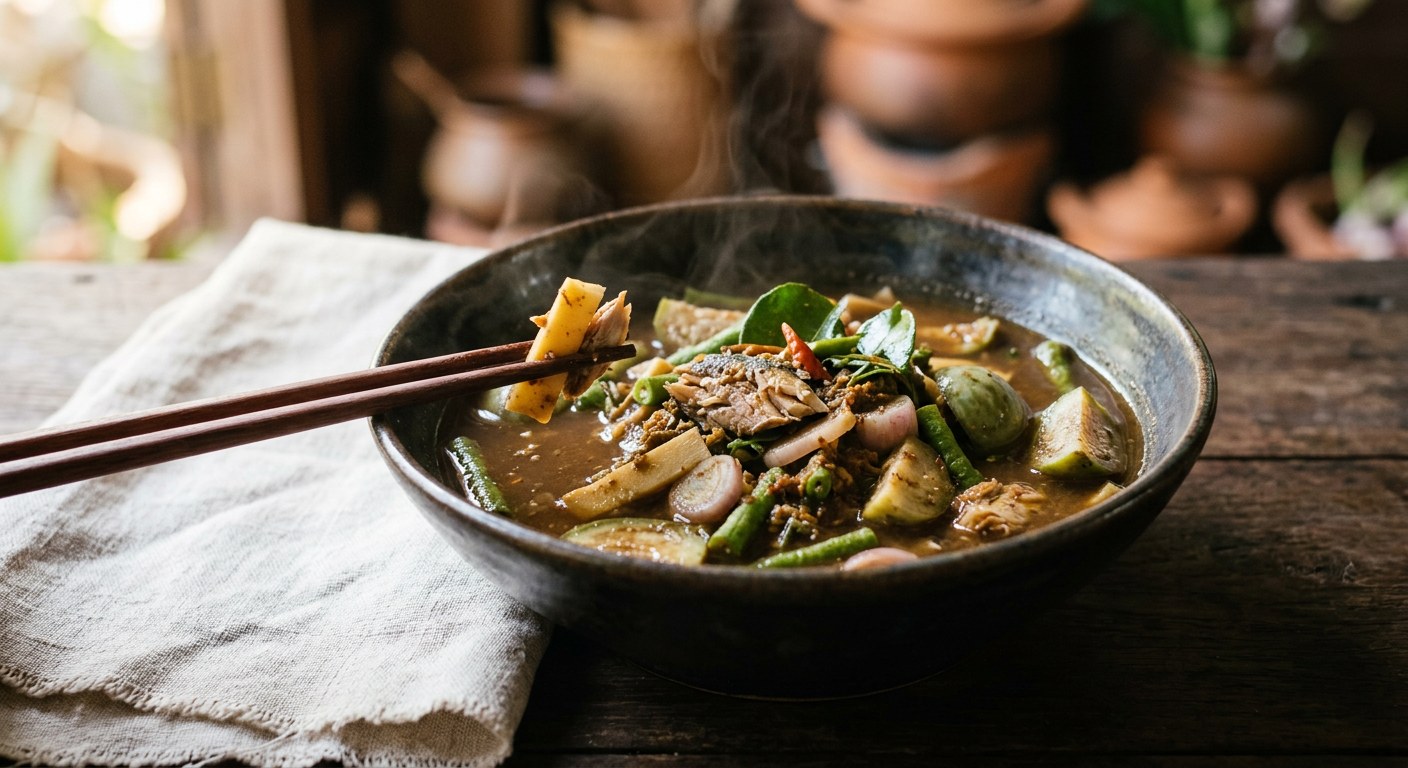
This recipe is translated from the following Thai-language sources. Where they disagree, we've said so.
1. Wongnai — "วิธีทำ 'แกงไตปลา' เมนูอาหารใต้เข้มข้นจนร้องซี้ด มาพร้อมสูตรพริกแกงสด!" (the recipe used here) — wongnai.com
2. Kapook — "แกงไตปลา อาหารใต้รสแซ่บใส่ผักเน้น ๆ" (the coconut-husk grilling and the TasteAtlas story) — cooking.kapook.com
3. TrueID Food — "สูตรทำ แกงไตปลา สูตรปักษ์ใต้แท้ๆ" by แม่ซี น้องมดดี้ (the selling batch) — food.trueid.net
4. Mahidol University Institute of Nutrition — "แกงไตปลา (ตำรับนี้รับประทานได้ประมาณ 4 คน)" by ผศ.ดร.สมศรี เจริญเกียรติกุล (the academic bowl) — inmu.mahidol.ac.th
5. TrueID Food — "สูตรทำ แกงไตปลาแห้ง เครื่องแกงตำเอง" by แม่ซี น้องมดดี้ (the dry version) — food.trueid.net