Recipe · Thailand · The Curry That Rescues A Sour Pineapple

Kaeng Kua Sapparod (แกงคั่วสับปะรด)

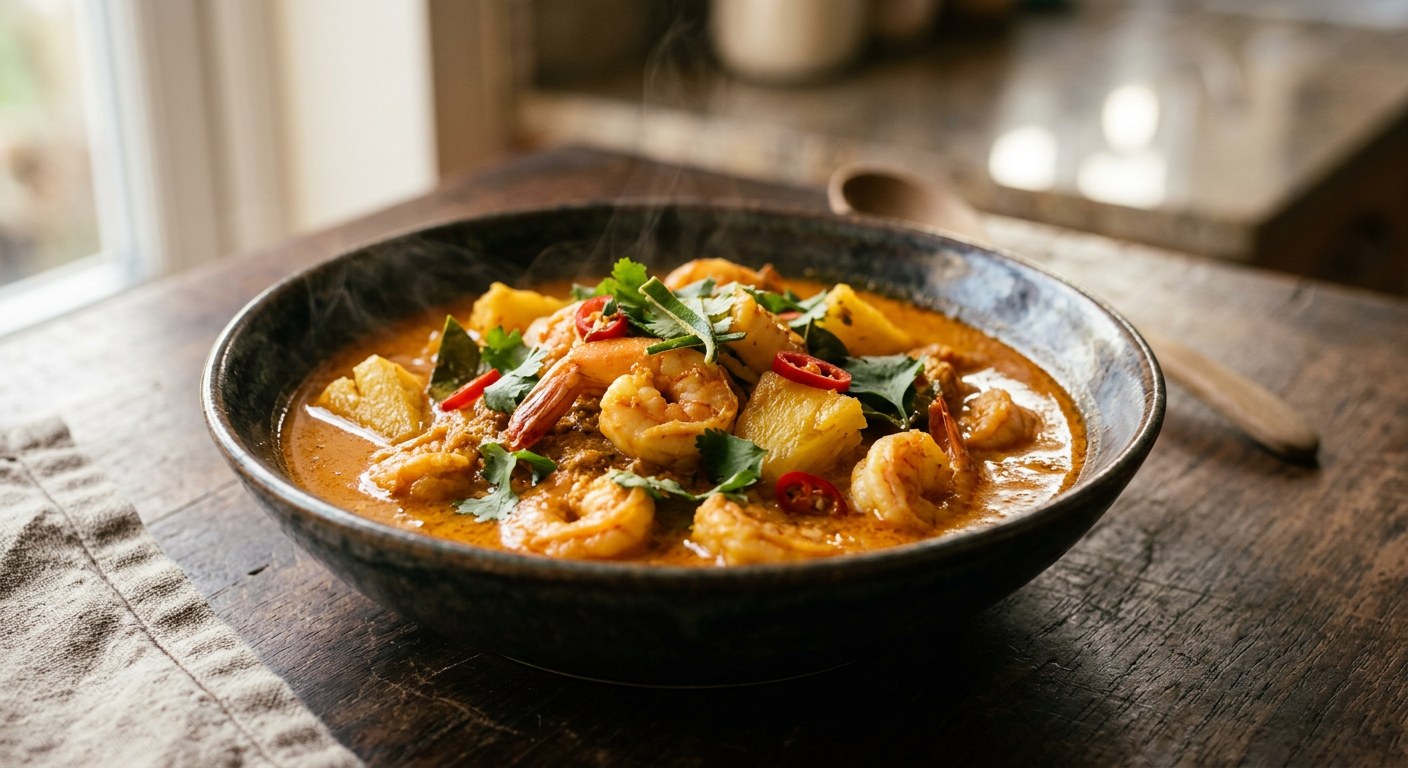
Curry paste fried in coconut milk until the oil splits, then sour pineapple, prawns and kaffir lime — the south's answer to the question of what to do with a pineapple too sharp to eat.

Kaeng Kua Sapparod — Pineapple curry with prawns — kaeng kua paste fried in coconut milk until the oil splits, then sour

The Curry That Names Its Technique

แกงคั่วสับปะรด splits neatly into its parts: คั่ว (kua) is the technique — curry paste fried in coconut milk until the fat breaks out and beads on the surface, a step every Thai source calls กะทิแตกมัน — and สับปะรด, the pineapple that becomes the body of the curry. No vegetable filler, no meat doing the heavy lifting: the pineapple is the dish.

It is, above all, a home curry. The Pantip cook whose post opens the topic made hers because a street-cart pineapple came home too sour to eat, and she notes you rarely see the dish for sale — prawns are too dear for a stall to give it away. Her fix, the same fix in every southern kitchen: if the pineapple won't do the souring, a spoon of tamarind water will.

The paste carries the south with it. The old-style kua paste, as tukata001's recipe teaches, is red curry paste with pounded dried fish worked in — that is what separates kua from a plain red curry, and Wongnai's mussel pot arrives at the same place by another road, pounding soaked dried shrimp into the paste. Kapook's editors add the practical footnote: if you like it properly hot, buy the southern kua paste.

The Recipe (home version, from Kapook / ครัวตุ๊กตา)

ThaiEnglishAmount
สับปะรดPineapple, cut small1
กุ้งPrawns200 g
น้ำพริกแกงคั่วKaeng kua curry paste3 tbsp
กะทิCoconut milk1 can
น้ำปลาFish sauce3 tbsp
น้ำตาลปี๊บPalm sugar1 tbsp
ใบมะกรูดKaffir lime leaves6

The mussel pot (Wongnai): ½ pineapple, ½ kg frozen NZ mussels, 100 g paste, 500 ml coconut milk, a handful of tamarind pulp, 3 tbsp dried shrimp — half of them pounded into the paste — seasoned with palm sugar and tamarind water, cooked in five minutes. The southern chicken pot (TrueID): 400 g chicken, 500 g pineapple, 150 g ready-made paste, 350 g coconut milk, eaten with rice or khanom jeen. The Pantip pot: prawns and mussels together, coconut milk, pineapple and Mae Ploy red curry paste — tamarind water only if the pineapple turns out sweet.

The Method

  1. The split. Heat the coconut milk in a wok until it boils, then add the curry paste and fry until fragrant. This is the step that decides the curry: fry patiently until the coconut milk breaks — the oil beads out and the paste turns glossy. Kapook and tukata001 both warn that rushing this step means the coconut never splits, and the curry never gets its colour.
  2. The prawns. Add the prawns to the split paste and fry briefly — half-cooked only. They will finish in the liquid.
  3. The coconut milk. Pour in the rest of the coconut milk, then tear in the kaffir lime leaves. The curry loosens, and the kaffir comes up through the steam.
  4. The pineapple. When the curry boils, add the pineapple and season with palm sugar and fish sauce. Go light on the palm sugar — the pineapple is the sweetener — and ease off the fish sauce if the paste is shop-bought, since most are already salty.
  5. The finish. Boil briefly and take it off the heat. Every source agrees here: do not simmer long, or the prawns turn unpleasant and the pineapple goes flat. Serve with hot rice; a fried egg and salted fish on the side, as the Pantip cook suggests, turn it into a feast.

Where Thai Sources Disagree

The protein. Prawns (Kapook, tukata001's Bloggang original), prawns and mussels together (Pantip), mussels alone (Wongnai), chicken (TrueID's southern cook). Pantip explains why the prawn version is special: it is rarely sold because prawns are expensive — the dish is a home curry, and it takes whatever protein the kitchen has.

The sour. Kapook, tukata001 and TrueID let the pineapple carry the sour on its own. Wongnai adds tamarind water as a full co-star. Pantip splits the difference: tamarind only if the pineapple isn't sharp enough. All four warn against adding much sugar — that is the point of the pineapple.

The paste. tukata001's old-style paste pounds dried fish (ปลาแห้ง) into red curry paste; Wongnai pounds soaked dried shrimp into the kua paste — the same instinct, two proteins. Wongnai and TrueID otherwise use ready-made kua paste, and Pantip shortcuts straight to Mae Ploy red curry paste. All still call the dish kaeng kua.

When the prawns go in. Kapook and tukata001 fry them briefly in the split coconut milk, half-cooked, before the rest of the liquid goes in. Pantip holds them back and adds them last, just until they are done. Both rules point the same way: never long-simmer prawns.

The kaffir lime leaves. Kapook and tukata001 add them with the pineapple, mid-cook, where they stew into the curry. Pantip, TrueID and Wongnai scatter them at the very end, so the aroma sits on top instead. The cooked-in version is deeper; the scattered version smells like the leaf itself.
How Western Versions Get It Wrong

UK Ingredient Notes

Sources

This recipe is translated from the following Thai-language sources. Where they disagree, we've said so.

1. Kapook Cooking — "แกงคั่วสับปะรดกุ้ง แกงไทยหอม ๆ พ่วงสูตรน้ำพริกแกงคั่วโบราณ" (the recipe used here) — cooking.kapook.com

2. Bloggang — "แกงคั่วสับปะรดใส่กุ้ง by ครัวตุ๊กตา" by tukata001 (the original post of the same recipe; the old-style dried-fish paste) — bloggang.com

3. Wongnai — "แกงคั่วสับปะรดหอยแมลงภู่" by GopOpOp (the mussel pot, tamarind and dried shrimp) — wongnai.com

4. Pantip — "แกงคั่วสับปะรดกุ้งสด" topic 36114869 (the sour-pineapple rescue story; the Mae Ploy shortcut) — pantip.com

5. TrueID Food — "เข้าครัวกับสาวใต้ EP.2 ทำแกงคั่วไก่สับปะรด" (the southern chicken pot, khanom jeen) — food.trueid.net

Johnny Tiger
Johnny researches and translates Thai recipes from Thai-language sources — chefs, restaurants and home cooks in Thailand — and publishes them with their sources cited. No westernised shortcuts, no invented steps.