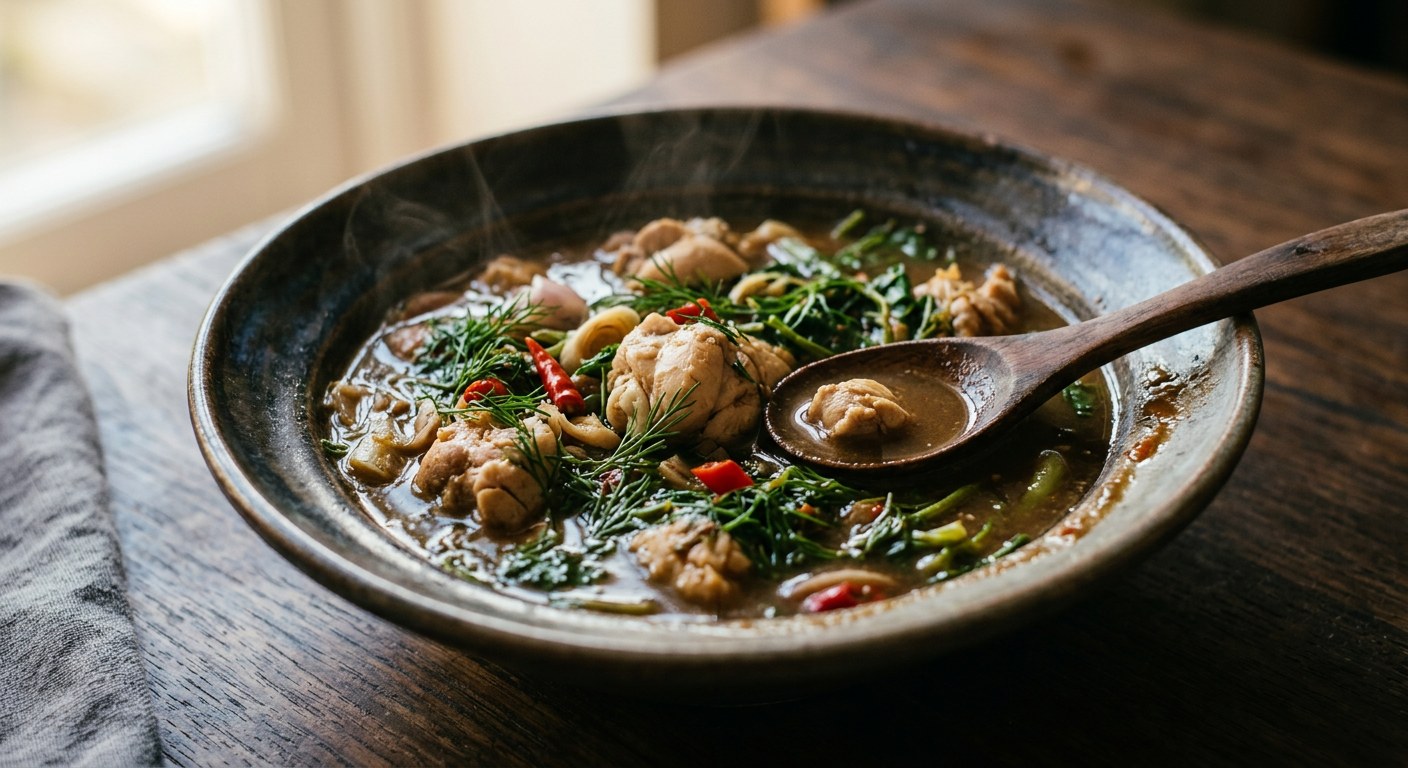
Chicken roasted with pounded chillies, lemongrass and shallots, simmered with pla ra, dill and a full pot of greens, thickened with toasted rice — Isaan's curry, and not a drop of coconut in it.
Mahidol University's Institute of Nutrition opens its recipe with the rule: in Isaan, if a dish is called a แกง — a curry — there is no coconut milk in it, and แกงอ่อม is the proof. The name follows whatever went in the pot: แกงอ่อมไก่ with chicken, อ่อมหมู with pork, อ่อมเนื้อ with beef — and the same pot takes fish or frog when the river provides.
The construction never changes. Aromatics are pounded, roasted in the pot, the meat fried into them, then water, pla ra and the greens. In Mahidol's kitchen version the vegetables outnumber the chicken — 344 g of cabbage, mustard leaves, pumpkin flowers, spring onions, dill and lemon basil against 304 g of meat. The dill (ผักชีลาว) is the dish's signature, the smell that announces it from across the market; toasted rice gives the broth its body.
One warning: the north has a namesake. Sanook's comparison lays it out — northern แกงอ่อม is a different curry under the same name, built on dried chilli, turmeric, shrimp paste and roasted coriander seed and cumin, fried with the meat without oil, no pla ra. Order one in Chiang Mai and you get the spice version; in Khon Kaen you get this one.
| Thai | English | Amount |
|---|---|---|
| พริกสด | Fresh red chillies | 8 g |
| หอมแดง | Shallots | 18 g |
| ตะไคร้ (ซอย) | Lemongrass, sliced | 11 g |
| เนื้อไก่ (ส่วนน่อง) | Chicken, drumstick meat | 304 g |
| น้ำปลา | Fish sauce | 5 g |
| น้ำสะอาด | Water | 600 g |
| ข้าวเบือ (คั่ว) | Toasted pounded rice | 9 g |
| น้ำปลาร้า | Pla ra (fermented fish sauce) | 21 g |
| น้ำตาลทราย | Sugar | 3 g |
| ใบมะกรูด | Kaffir lime leaves | 4 leaves |
| ผักกาดขาว | Chinese cabbage | 120 g |
| ผักกาดเขียว | Leaf mustard | 47 g |
| ดอกฟักทอง | Pumpkin flowers | 43 g |
| ต้นหอม | Spring onions | 64 g |
| ผักชีลาว | Dill | 55 g |
| ใบแมงลัก | Lemon basil | 15 g |
The quick pork version (Wongnai, 538k reads): 300 g pork neck, 4–5 red chillies pounded with 2 cloves of garlic, roasted with the pork in the pot, 3 tbsp pla ra, water, one head of Chinese cabbage and 2 bunches of dill — no rice powder, 1 tbsp sugar instead. Aroifin's pork-belly pot: a ladle of pla ra, salt, MSG and 2 tbsp toasted rice powder, choy sum instead of cabbage. Kapook's no-pla-ra version: chicken stock instead of water, galangal and fingerroot in the paste, pea aubergines added. Tumkinaeng's beef version: 300 g beef ribs, kaffir lime leaves torn in by hand, and 2–3 tbsp beef blood stirred into the boiling pot to thicken it. The northern namesake (Sanook): a different curry — dried chilli, turmeric, shrimp paste, roasted coriander seed and cumin, fried without oil.
Pla ra or not. Every source but one cooks with pla ra. Kapook's ครัวตุ๊กตา version deliberately omits it — the family never ate it — and swaps in chicken stock and fish sauce, adding "if you want it, put it in at the seasoning step". The rest treat it as the dish's backbone.
The thickener. Toasted rice powder (Aroifin 2 tbsp, Kapook 3 tbsp) versus toasted pounded rice — ข้าวเบือคั่ว (Mahidol, 9 g) versus raw soaked pounded rice — ข้าวเบือ (ครูกุลชญา, 2 tbsp) versus beef blood stirred in at a rolling boil (Tumkinaeng) versus nothing at all (Wongnai's ครัวตามใจทอม, whose readers comment to add it).
Garlic in the paste. Aroifin pounds in 5–6 cloves, Wongnai's pot is chilli and garlic only, Kapook and ครูกุลชญา include it — but Mahidol's paste and Tumkinaeng's are chilli, shallot and lemongrass, no garlic. The garlicless pots let the dill and pla ra lead.
Coarse or fine. Aroifin, Kapook and ครัวตามใจทอม pound the paste coarse; Mahidol and ครูกุลชญา pound it fine. A coarse paste leaves flecks that catch on the meat; a fine one dissolves into the broth.
The liquid. Water (Mahidol, ครูกุลชญา), chicken stock (Kapook), or the water used to rinse the mortar — the frugal move that wastes none of the paste (Aroifin, Tumkinaeng).
The simmer. Aroifin's pork-belly pot is done in 20 minutes of cooking; ครูกุลชญา's free-range chicken simmers covered for two hours and twenty minutes. Same dish, different bird.
Sugar. Mahidol adds 3 g and ครัวตามใจทอม a full tablespoon to round the pla ra; the other pots add none — salty, hot, herbal, and nothing else.
Salt's hiding place. Mahidol records the village trick: pound salt in with the chillies to make the paste easier to grind and kill the raw green smell — then hold back on fish sauce and pla ra because the salt is already in there. Aroifin salts the pot instead.
North versus Isaan. Sanook's comparison: the northern namesake uses dried chilli, turmeric, shrimp paste, roasted coriander seed and cumin, fried without oil, seasoned with salt or fish sauce — spice-led and milder. The Isaan version is hot, salty and นัว from the pla ra. Same name, different curry.
This recipe is translated from the following Thai-language sources. Where they disagree, we've said so.
1. Mahidol University Institute of Nutrition — "แกงอ่อมไก่ (ตำรับนี้รับประทานได้ประมาณ 4 คน)" (the recipe used here) — inmu.mahidol.ac.th
2. Wongnai — "สูตร แกงอ่อมอีสาน พร้อมวิธีทำโดย ครัวตามใจทอม" (the 538k-read quick pork version) — wongnai.com
3. Kapook — "แกงอ่อมไก่บ้าน สูตรไม่ใส่ปลาร้า รสแซ่บผักเพียบดีต่อใจ" by ครัวตุ๊กตา (the no-pla-ra version) — cooking.kapook.com
4. ทำกินเอง — "อ่อมเนื้อ สูตรลับแซ่บแบบอีสาน ใช้เนื้อส่วนนี้อร่อยที่สุด" (the beef and blood version) — tumkinaeng.com
5. Aroifin — "วิธีทำ แกงอ่อมหมู แบบอีสานแท้ รสแซ่บนัว ผักแน่นเต็มหม้อ" (the pork-belly pot with mortar water) — aroifin.com
6. Wongnai — "สูตร แกงอ่อมไก่บ้าน พร้อมวิธีทำโดย ครูกุลชญา ศิริไทย" (the long-simmered free-range pot) — wongnai.com
7. Sanook — "ไขข้อสงสัย ทำไม 'แกงอ่อม' ของเหนือและอีสานถึงไม่เหมือนกัน?" (the north-versus-Isaan comparison) — sanook.com