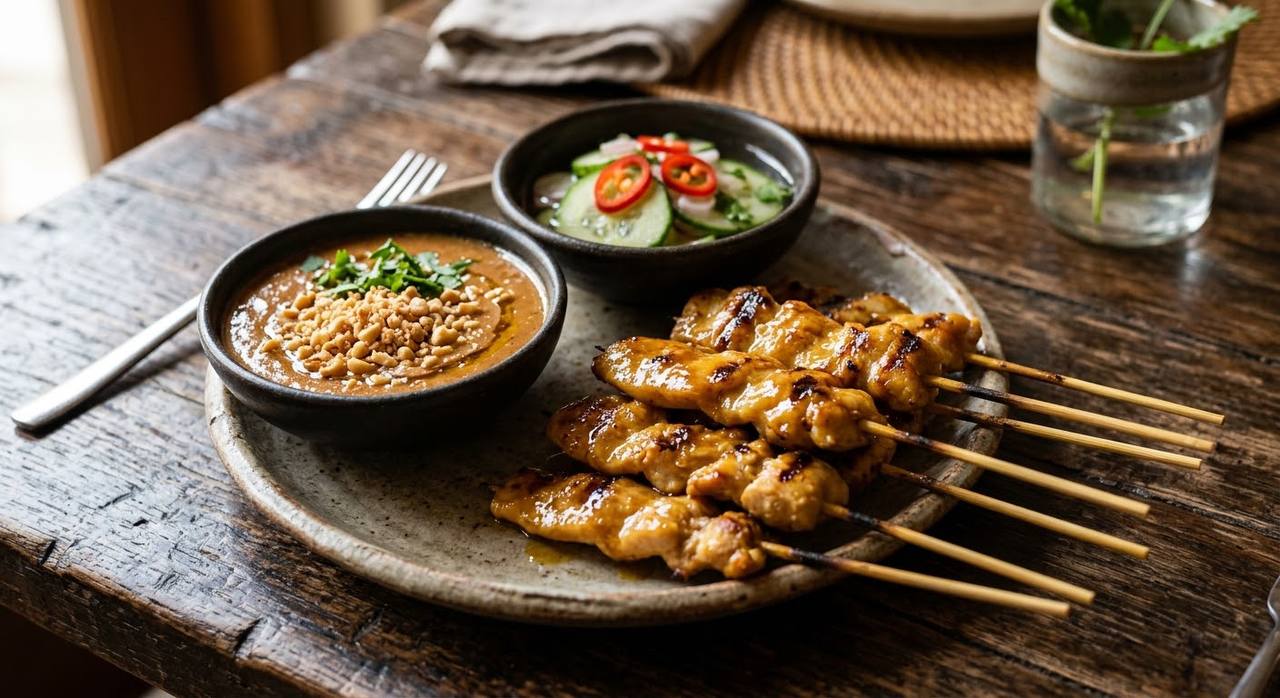
Thin chicken in a coconut-milk marinade of pounded coriander seed, galangal and lemongrass, grilled and basted until glossy — served with a peanut sauce built on roasted peanuts and curry paste, and the ajad pickle that cuts it.
Satay is a traveller. Thai food writers are open that the dish came to Thailand through the Malay world — most likely brought by Muslim traders — and the Thai kitchen made it its own. What makes the Thai version Thai is the coconut-milk marinade, the cumin-turmeric-curry-powder warmth, and the habit of basting the skewers with sweetened coconut milk while they grill, so the surface stays glossy instead of charring dry.
Then there's the sauce. In Thailand it is built from roasted peanuts pounded fine, cooked into coconut milk with curry paste — the sources split between massaman-plus-red and roasted red paste — sweetened with palm sugar and sharpened with tamarind. It is savoury, nutty and slightly hot. It is not the sweet peanut-butter gloop of western takeaways.
And the pickle matters as much as the sauce. Ajad — cucumber, red chilli and shallots in a hot-sweet vinegar brine — is the fresh crunch that keeps the whole plate from being rich. Satay without ajad is only two thirds of the dish.
| Thai | English | Amount |
|---|---|---|
| The marinade | ||
| สะโพกไก่ (แล่บาง) | Chicken thigh, sliced thin | 500 g |
| ลูกผักชี | Coriander seeds | 1½ tbsp |
| ข่า (สับ) | Galangal, chopped | 1 tsp |
| ตะไคร้ (ซอย) | Lemongrass, sliced fine | 1½ tbsp |
| หัวกะทิ | Head coconut milk | ½ cup |
| ยี่หร่าป่น | Ground cumin | ½ tbsp |
| ผงขมิ้น | Turmeric powder | 1 tsp |
| ผงกะหรี่ | Curry powder | 1 tsp |
| น้ำตาลทราย | Sugar | 1½ tbsp |
| เกลือ | Salt — the source's amount; halve it if you prefer | 1 tbsp |
| พริกไทยป่น | Ground pepper | 1 tbsp |
| For grilling | ||
| หัวกะทิ + นมสด | Head coconut milk and fresh milk, mixed — for basting | 1 cup + 1 cup |
| The peanut sauce (น้ำจิ้มสะเต๊ะ) | ||
| กะทิ | Coconut milk | 300 ml |
| ถั่วลิสงคั่วป่น | Roasted peanuts, ground fine | 200 g |
| พริกแกงมัสมั่น | Massaman curry paste | 20 g |
| พริกแกงแดง | Red curry paste | 20 g |
| น้ำตาลปี๊บ | Palm sugar | 80 g |
| น้ำมะขามเปียก | Tamarind water | 4 tbsp |
| เกลือป่น | Salt | ½ tsp |
| The ajad (อาจาด) | ||
| น้ำส้มสายชู + น้ำตาล + เกลือ + น้ำ | Rice vinegar, sugar, salt and water, simmered | as needed + 70 ml |
| แตงกวา · พริกชี้ฟ้าแดง · หอมแดง | Cucumber, red spur chilli, shallots — sliced | 1 · 1 · 2 |
Peanut butter vs peanuts. The classic grinds roasted peanuts and cooks them into the sauce. Home cooks and shortcut blogs openly use peanut butter — the modern habit, not the original. Both appear in Thai sources; the recipe above is the ground-peanut version.
The sauce's paste base. Wongnai builds it on massaman paste plus red curry paste; Phol's version fries a roasted curry paste (พริกแกงคั่ว) first. Both produce a savoury, curry-scented sauce — the point is that a curry paste belongs in it.
The marinade spices. The cumin-turmeric-curry-powder trio (Wongnai) against the simpler galangal-lemongrass-black-pepper pound (Phol). One is warmer, one is cleaner; both are published as ไก่สะเต๊ะ.
Salt. The Wongnai source prints a full tablespoon for 500 g of chicken. Home versions run lighter. We've transcribed the source amount and flagged it.
The pickle. Ajad appears in nearly every Thai recipe — but some home cooks serve satay with sweet chilli sauce instead. The sources treat ajad as the standard and the sweet chilli as the market shortcut.
The origin story. Thai sources agree satay travelled from the Malay world via Muslim traders; the exact route is argued. The Thai version's coconut-milk character is the settled part.
This recipe is translated from the following Thai-language sources. Where they disagree, we've said so.
1. Wongnai (pimtp__) — "วิธีทำ ไก่สะเต๊ะ เมนูย่างสุดเด็ด" (4 Jan 2019 — full marinade, basting liquid and peanut-sauce quantities) — wongnai.com
2. Phol Food Mafia — "Chicken Satay (ไก่สะเต๊ะ)" สูตรโดย พล ตัณฑเสถียร (marinade pound, ajad and the roasted-paste sauce method) — pholfoodmafia.com
3. BlogGang (tabtimsiam) — "สูตรหมูสะเต๊ะ -ไก่สะเต๊ะ" (home-cook discussion incl. the peanut-butter shortcut) — bloggang.com